
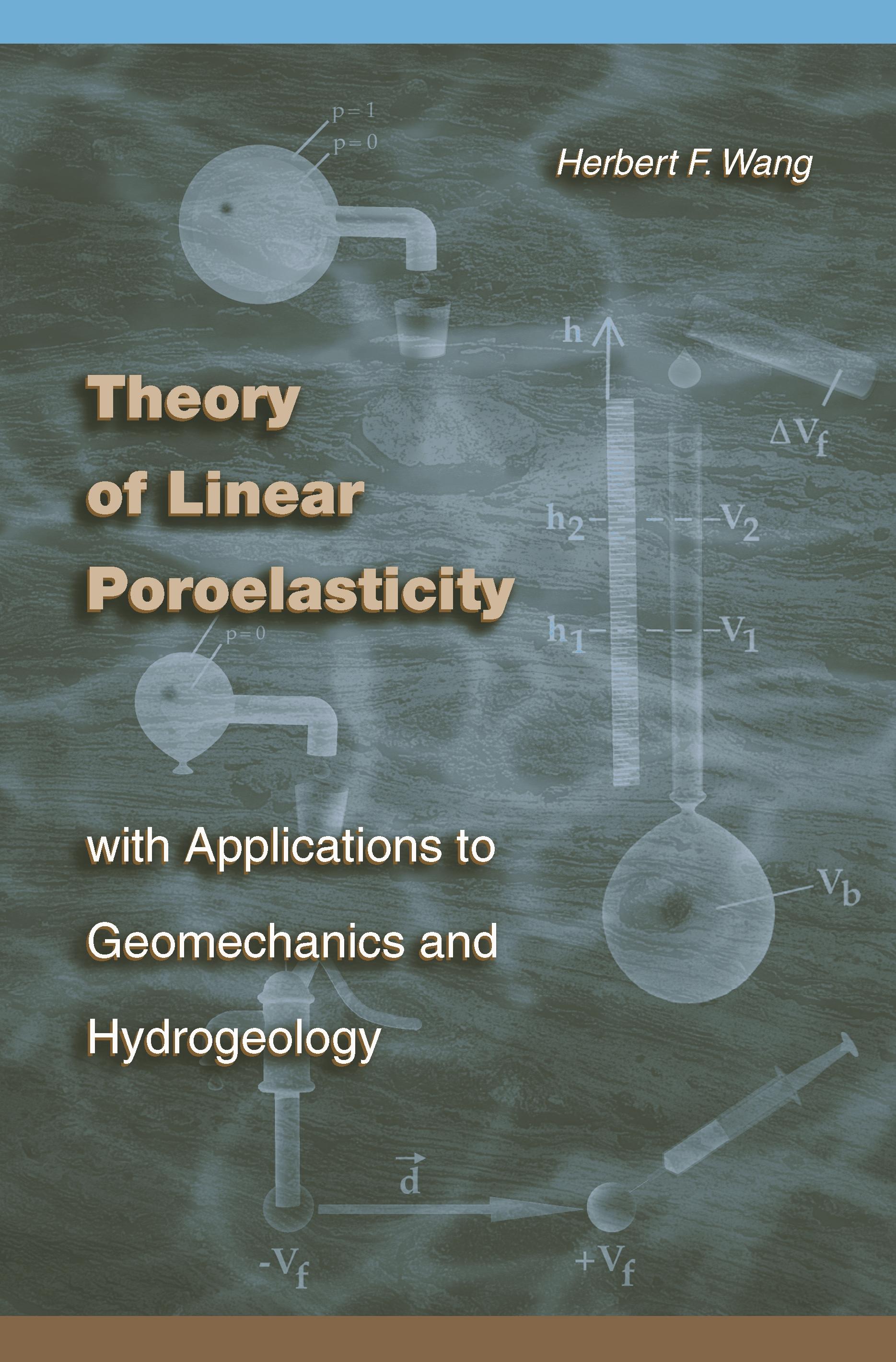
The theory of linear poroelasticity describes the interaction between mechanical effects and adding or removing fluid from rock. It is critical to the study of such geological phenomena as earthquakes and landslides and is important for numerous engineering projects, including dams, groundwater withdrawal, and petroleum extraction. Now an advanced text synthesizes in one place, with one notation, numerous classical solutions and applications of this highly useful theory.
The introductory chapter recounts parallel developments in geomechanics, hydrogeology, and reservoir engineering that are unified by the tenets of poroelasticity. Next, the theory's constitutive and governing equations and their associated material parameters are described. These equations are then specialized for different simplifying geometries: unbounded problem domains, uniaxial strain, plane strain, radial symmetry, and axisymmetry. Example problems from geomechanics, hydrogeology, and petroleum engineering are incorporated throughout to illustrate poroelastic behavior and solution methods for a wide variety of real-world scenarios. The final chapter provides outlines for finite-element and boundary-element formulations of the field's governing equations. Whether read as a course of study or consulted as a reference by researchers and professionals, this volume's user-friendly presentation makes accessible one of geophysics' most important subjects and will do much to reduce poroelasticity's reputation as difficult to master.
Pay easily by card, Klarna, Apple Pay or Google Pay. Not happy? You always have a 14-day money-back guarantee. Read more in our terms. If you have any questions, email us at hello@memmo.org.
Memmo makes studying easier – wherever you are in the world. We bring your course books and smart study tools together in one place: summaries, quizzes, podcasts and flashcards. Plus Ted, your study buddy who answers anything you wonder. Over 50,000 students already study here – built to help you learn faster and stress less.