
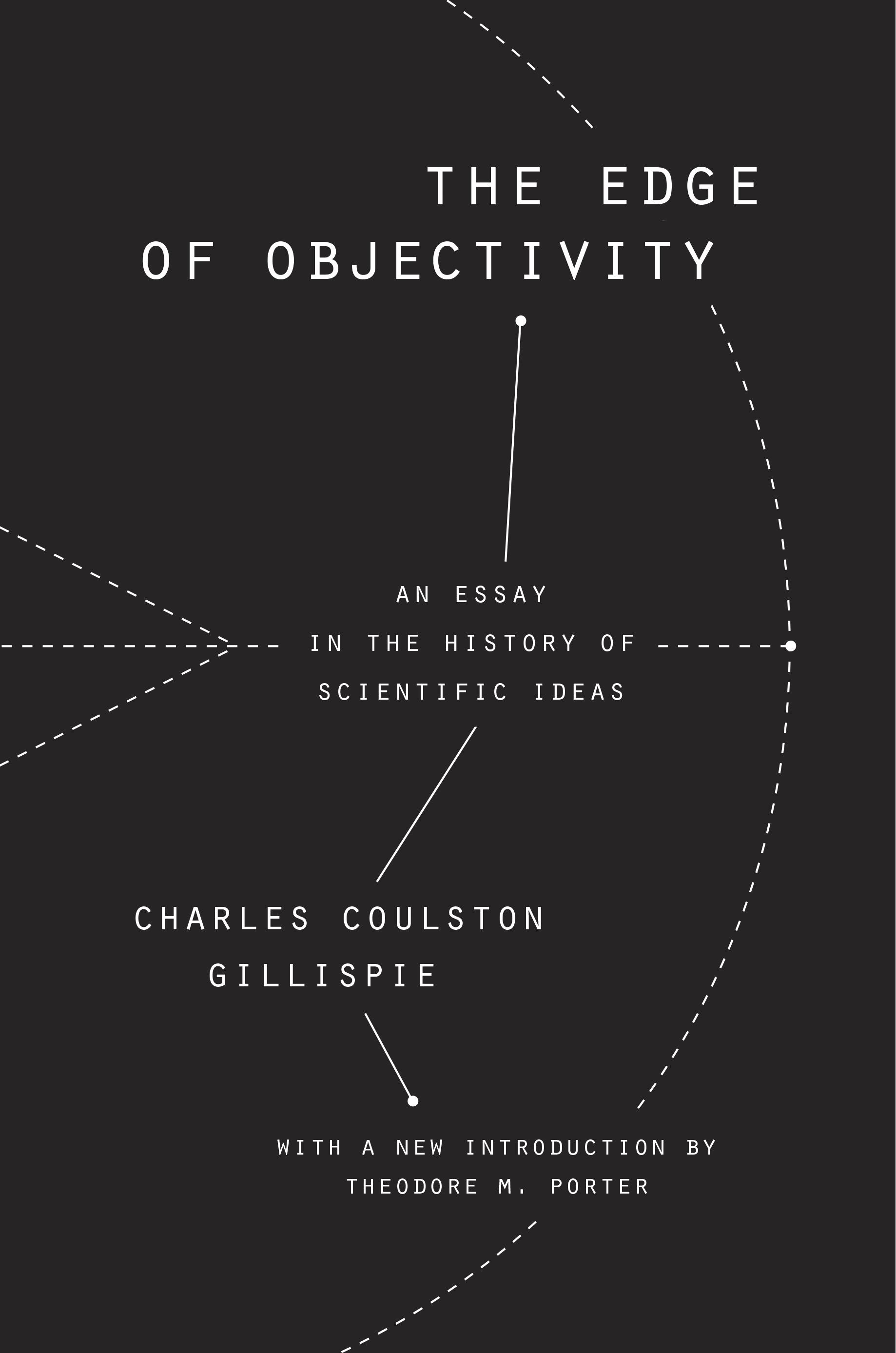
Originally published in 1960, The Edge of Objectivity helped to establish the history of science as a full-fledged academic discipline. In the mid-1950s, a young professor at Princeton named Charles Gillispie began teaching Humanities 304, one of the first undergraduate courses offered anywhere in the world on the history of science. From Galileo's analysis of motion to theories of evolution and relativity, Gillispie introduces key concepts, individuals, and themes. The Edge of Objectivity arose out of this course.
It must have been a lively class. The Edge of Objectivity is pointed, opinionated, and selective. Even at six hundred pages, the book is, as the title suggests, an essay. Gillispie is unafraid to rate Mendel higher than Darwin, Maxwell above Faraday. Full of wry turns of phrase, the book effectively captures people and places. And throughout the book, Gillispie pushes an argument. He views science as the progressive development of more objective, detached, mathematical ways of viewing the world, and he orchestrates his characters and ideas around this theme.
This edition of Charles Coulston Gillispie’s landmark book introduces a new generation of readers to his provocative and enlightening account of the advancement of scientific thought over the course of four centuries. Since the original publication of The Edge of Objectivity, historians of science have focused increasingly on the social context of science rather than its internal dynamics, and they have frequently viewed science more as a threatening instance of power than as an accumulation of knowledge. Nevertheless, Gillispie’s book remains a sophisticated, fast-moving, idiosyncratic account of the development of scientific ideas over four hundred years, by one of the founding intellects in the history of science.
Featuring a new foreword by Theodore Porter, who places the work in its intellectual context and the development of the field, this edition of The Edge of Objectivity is a monumental work by one of the founding intellects of the history of science.
Pay easily by card, Klarna, Apple Pay or Google Pay. Not happy? You always have a 14-day money-back guarantee. Read more in our terms. If you have any questions, email us at hello@memmo.org.
Memmo makes studying easier – wherever you are in the world. We bring your course books and smart study tools together in one place: summaries, quizzes, podcasts and flashcards. Plus Ted, your study buddy who answers anything you wonder. Over 50,000 students already study here – built to help you learn faster and stress less.