
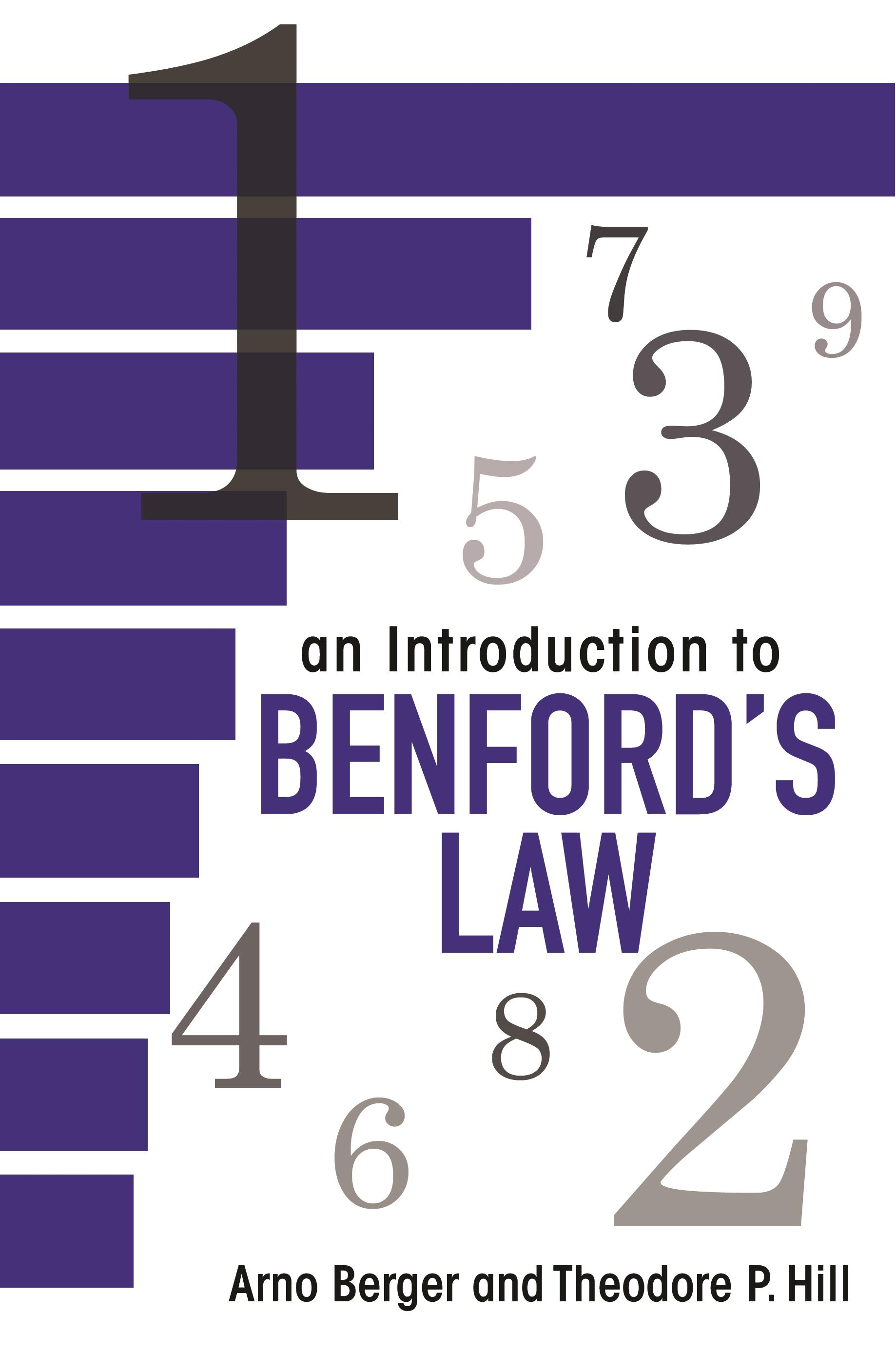
This book provides the first comprehensive treatment of Benford's law, the surprising logarithmic distribution of significant digits discovered in the late nineteenth century. Establishing the mathematical and statistical principles that underpin this intriguing phenomenon, the text combines up-to-date theoretical results with overviews of the law’s colorful history, rapidly growing body of empirical evidence, and wide range of applications.
An Introduction to Benford’s Law begins with basic facts about significant digits, Benford functions, sequences, and random variables, including tools from the theory of uniform distribution. After introducing the scale-, base-, and sum-invariance characterizations of the law, the book develops the significant-digit properties of both deterministic and stochastic processes, such as iterations of functions, powers of matrices, differential equations, and products, powers, and mixtures of random variables. Two concluding chapters survey the finitely additive theory and the flourishing applications of Benford’s law.
Carefully selected diagrams, tables, and close to 150 examples illuminate the main concepts throughout. The text includes many open problems, in addition to dozens of new basic theorems and all the main references. A distinguishing feature is the emphasis on the surprising ubiquity and robustness of the significant-digit law. This text can serve as both a primary reference and a basis for seminars and courses.
Pay easily by card, Klarna, Apple Pay or Google Pay. Not happy? You always have a 14-day money-back guarantee. Read more in our terms. If you have any questions, email us at hello@memmo.org.
Memmo makes studying easier – wherever you are in the world. We bring your course books and smart study tools together in one place: summaries, quizzes, podcasts and flashcards. Plus Ted, your study buddy who answers anything you wonder. Over 75,000 students already study here – built to help you learn faster and stress less.