
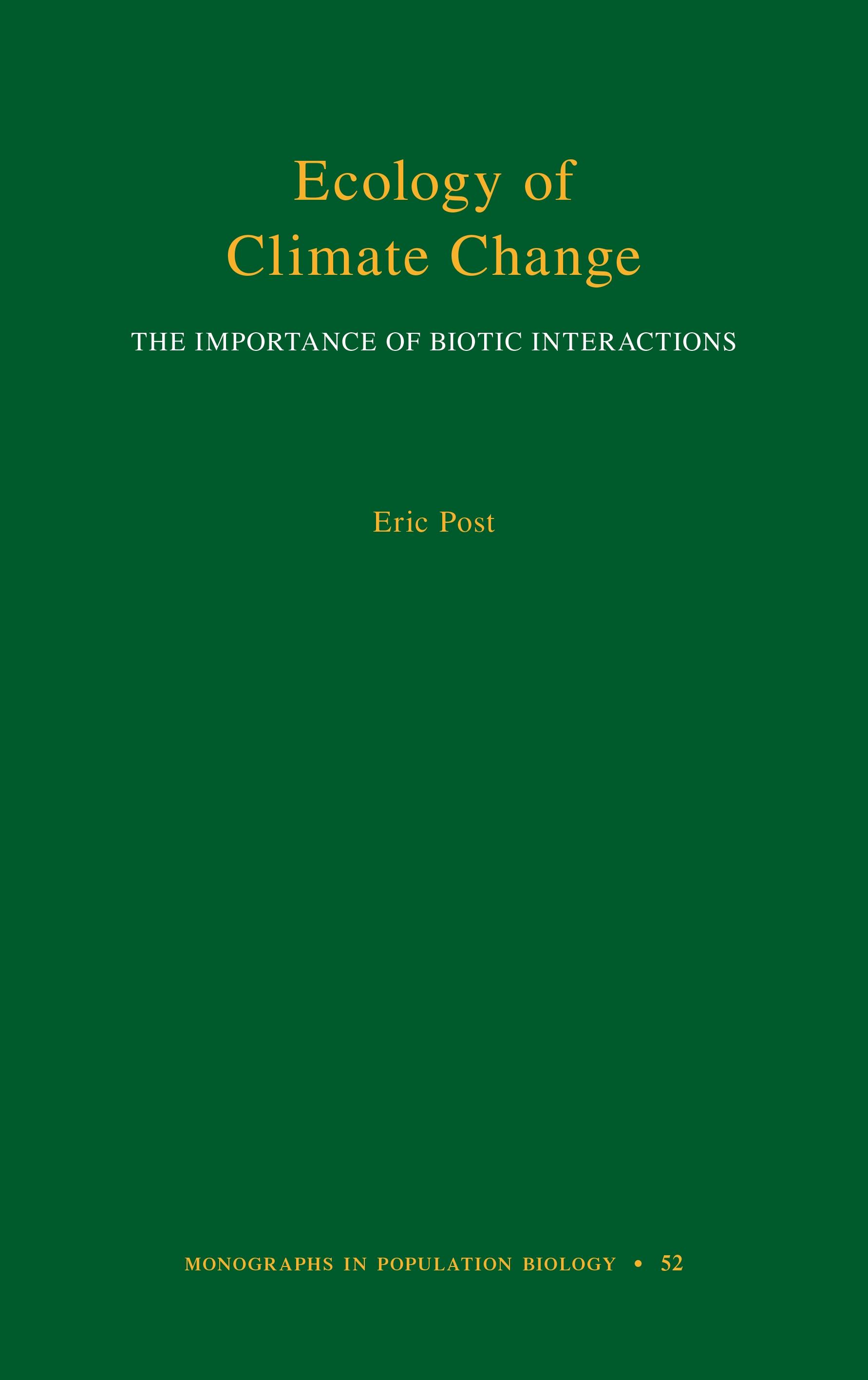
Rising temperatures are affecting organisms in all of Earth's biomes, but the complexity of ecological responses to climate change has hampered the development of a conceptually unified treatment of them. In a remarkably comprehensive synthesis, this book presents past, ongoing, and future ecological responses to climate change in the context of two simplifying hypotheses, facilitation and interference, arguing that biotic interactions may be the primary driver of ecological responses to climate change across all levels of biological organization.
Eric Post's synthesis and analyses of ecological consequences of climate change extend from the Late Pleistocene to the present, and through the next century of projected warming. His investigation is grounded in classic themes of enduring interest in ecology, but developed around novel conceptual and mathematical models of observed and predicted dynamics. Using stability theory as a recurring theme, Post argues that the magnitude of climatic variability may be just as important as the magnitude and direction of change in determining whether populations, communities, and species persist. He urges a more refined consideration of species interactions, emphasizing important distinctions between lateral and vertical interactions and their disparate roles in shaping responses of populations, communities, and ecosystems to climate change.
Pay easily by card, Klarna, Apple Pay or Google Pay. Not happy? You always have a 14-day money-back guarantee. Read more in our terms. If you have any questions, email us at hello@memmo.org.
Memmo makes studying easier – wherever you are in the world. We bring your course books and smart study tools together in one place: summaries, quizzes, podcasts and flashcards. Plus Ted, your study buddy who answers anything you wonder. Over 50,000 students already study here – built to help you learn faster and stress less.