
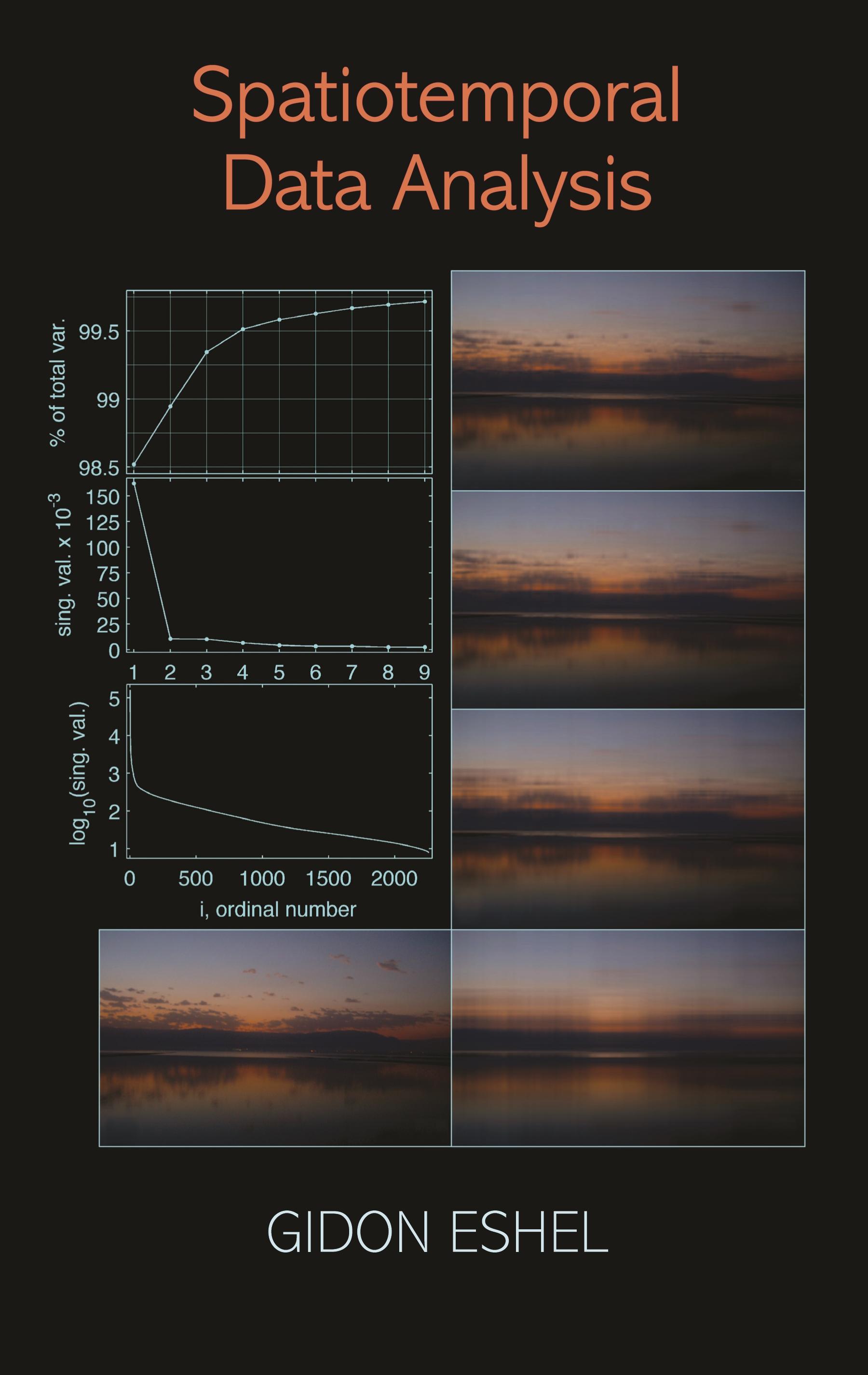
A severe thunderstorm morphs into a tornado that cuts a swath of destruction through Oklahoma. How do we study the storm's mutation into a deadly twister? Avian flu cases are reported in China. How do we characterize the spread of the flu, potentially preventing an epidemic? The way to answer important questions like these is to analyze the spatial and temporal characteristics--origin, rates, and frequencies--of these phenomena. This comprehensive text introduces advanced undergraduate students, graduate students, and researchers to the statistical and algebraic methods used to analyze spatiotemporal data in a range of fields, including climate science, geophysics, ecology, astrophysics, and medicine.
Gidon Eshel begins with a concise yet detailed primer on linear algebra, providing readers with the mathematical foundations needed for data analysis. He then fully explains the theory and methods for analyzing spatiotemporal data, guiding readers from the basics to the most advanced applications. This self-contained, practical guide to the analysis of multidimensional data sets features a wealth of real-world examples as well as sample homework exercises and suggested exams.
Pay easily by card, Klarna, Apple Pay or Google Pay. Not happy? You always have a 14-day money-back guarantee. Read more in our terms. If you have any questions, email us at hello@memmo.org.
Memmo makes studying easier – wherever you are in the world. We bring your course books and smart study tools together in one place: summaries, quizzes, podcasts and flashcards. Plus Ted, your study buddy who answers anything you wonder. Over 75,000 students already study here – built to help you learn faster and stress less.