
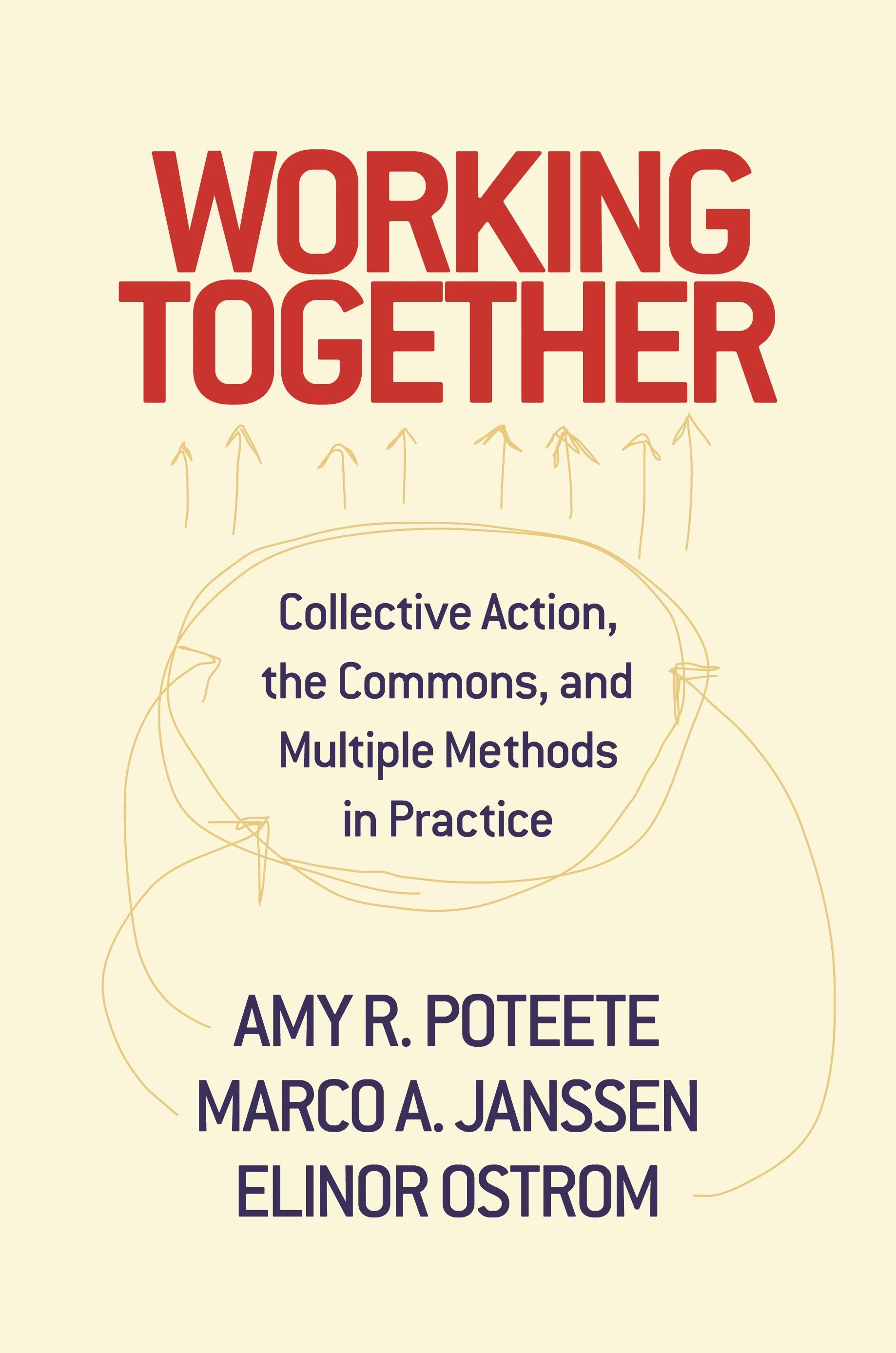
Advances in the social sciences have emerged through a variety of research methods: field-based research, laboratory and field experiments, and agent-based models. However, which research method or approach is best suited to a particular inquiry is frequently debated and discussed. Working Together examines how different methods have promoted various theoretical developments related to collective action and the commons, and demonstrates the importance of cross-fertilization involving multimethod research across traditional boundaries. The authors look at why cross-fertilization is difficult to achieve, and they show ways to overcome these challenges through collaboration.
The authors provide numerous examples of collaborative, multimethod research related to collective action and the commons. They examine the pros and cons of case studies, meta-analyses, large-N field research, experiments and modeling, and empirically grounded agent-based models, and they consider how these methods contribute to research on collective action for the management of natural resources. Using their findings, the authors outline a revised theory of collective action that includes three elements: individual decision making, microsituational conditions, and features of the broader social-ecological context.
Acknowledging the academic incentives that influence and constrain how research is conducted, Working Together reworks the theory of collective action and offers practical solutions for researchers and students across a spectrum of disciplines.
Pay easily by card, Klarna, Apple Pay or Google Pay. Not happy? You always have a 14-day money-back guarantee. Read more in our terms. If you have any questions, email us at hello@memmo.org.
Memmo makes studying easier – wherever you are in the world. We bring your course books and smart study tools together in one place: summaries, quizzes, podcasts and flashcards. Plus Ted, your study buddy who answers anything you wonder. Over 50,000 students already study here – built to help you learn faster and stress less.