
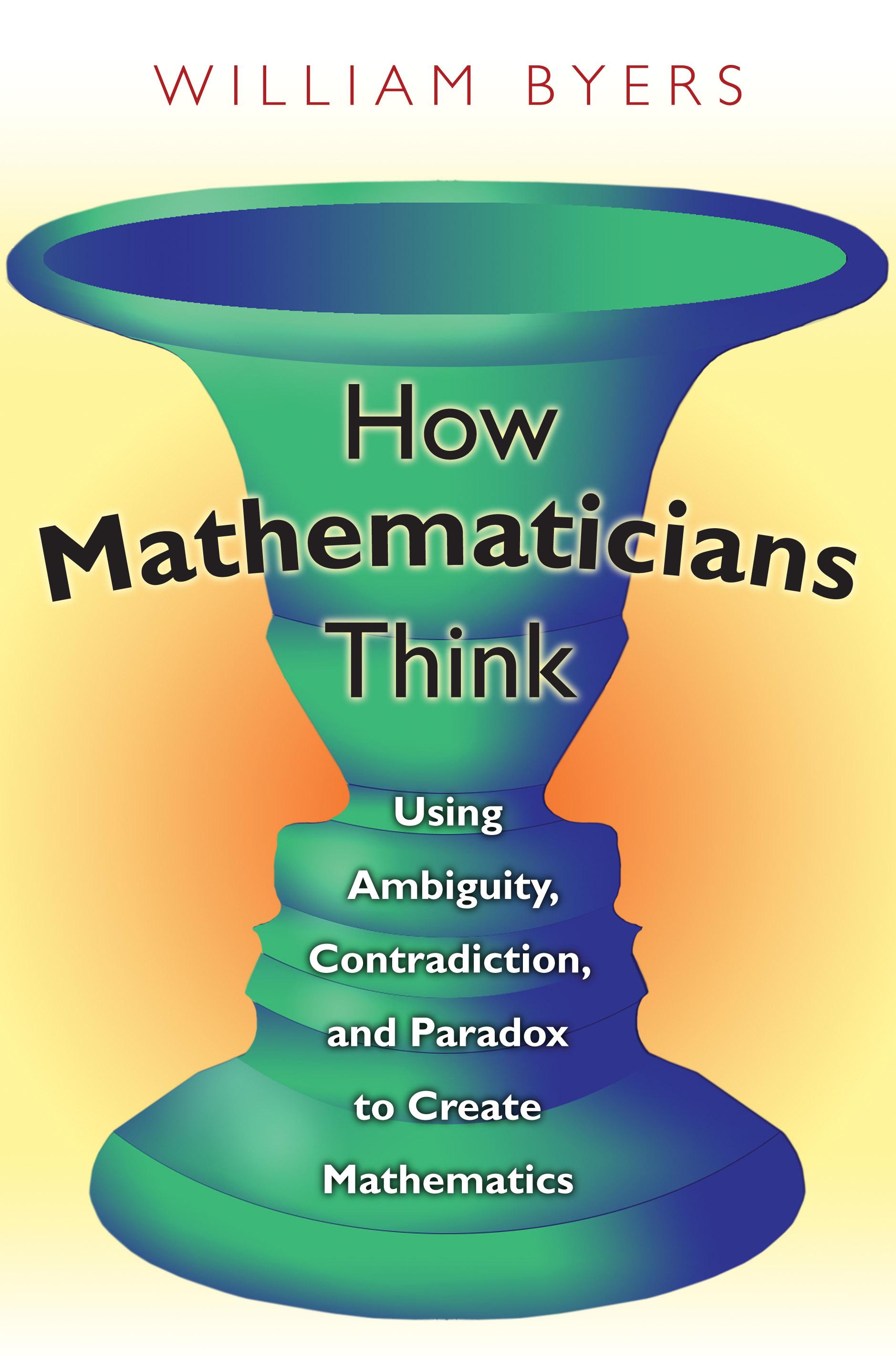
To many outsiders, mathematicians appear to think like computers, grimly grinding away with a strict formal logic and moving methodically--even algorithmically--from one black-and-white deduction to another. Yet mathematicians often describe their most important breakthroughs as creative, intuitive responses to ambiguity, contradiction, and paradox. A unique examination of this less-familiar aspect of mathematics, How Mathematicians Think reveals that mathematics is a profoundly creative activity and not just a body of formalized rules and results.
Nonlogical qualities, William Byers shows, play an essential role in mathematics. Ambiguities, contradictions, and paradoxes can arise when ideas developed in different contexts come into contact. Uncertainties and conflicts do not impede but rather spur the development of mathematics. Creativity often means bringing apparently incompatible perspectives together as complementary aspects of a new, more subtle theory. The secret of mathematics is not to be found only in its logical structure.
The creative dimensions of mathematical work have great implications for our notions of mathematical and scientific truth, and How Mathematicians Think provides a novel approach to many fundamental questions. Is mathematics objectively true? Is it discovered or invented? And is there such a thing as a "final" scientific theory?
Ultimately, How Mathematicians Think shows that the nature of mathematical thinking can teach us a great deal about the human condition itself.
Pay easily by card, Klarna, Apple Pay or Google Pay. Not happy? You always have a 14-day money-back guarantee. Read more in our terms. If you have any questions, email us at hello@memmo.org.
Memmo makes studying easier – wherever you are in the world. We bring your course books and smart study tools together in one place: summaries, quizzes, podcasts and flashcards. Plus Ted, your study buddy who answers anything you wonder. Over 75,000 students already study here – built to help you learn faster and stress less.