
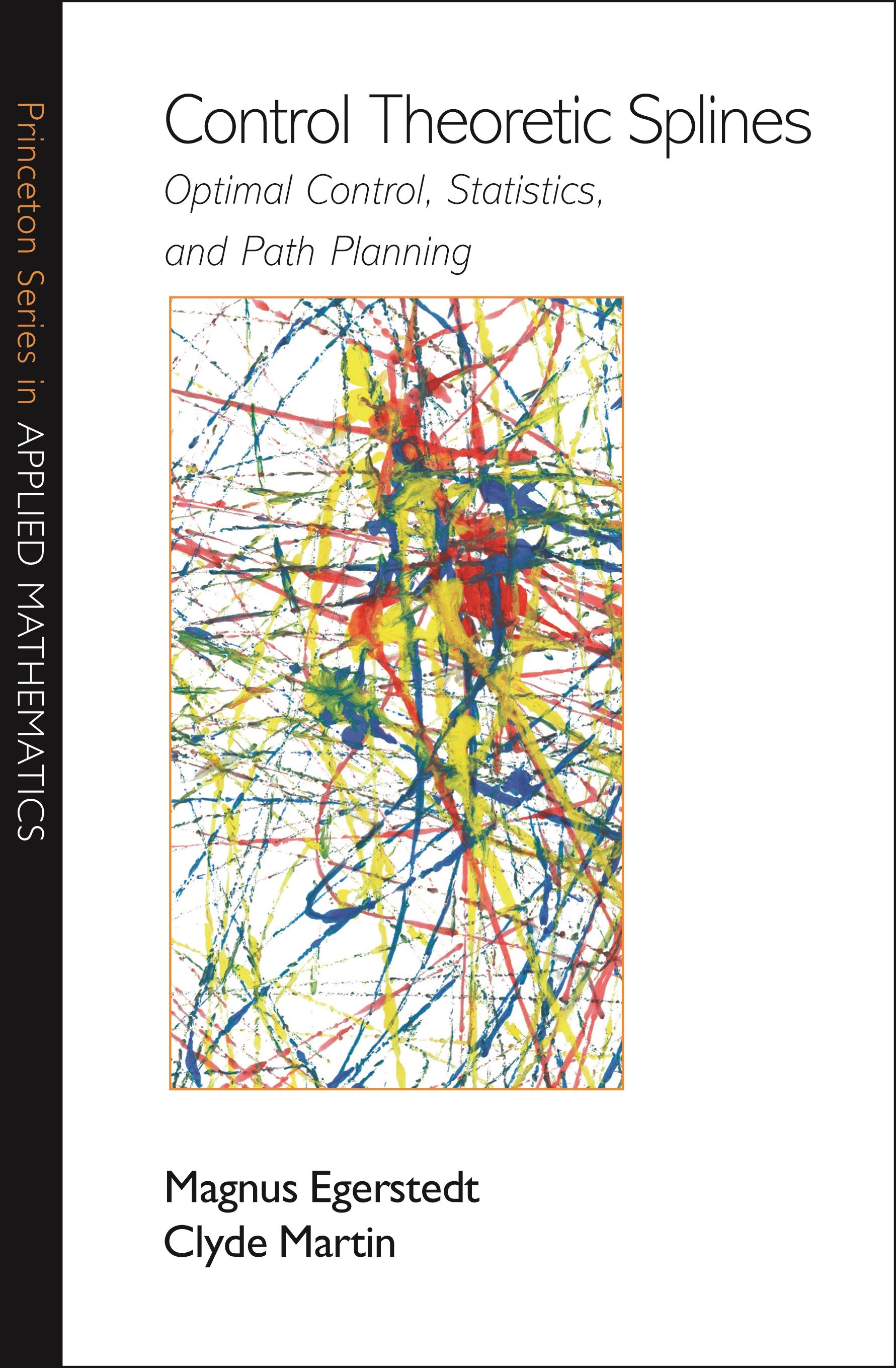
Splines, both interpolatory and smoothing, have a long and rich history that has largely been application driven. This book unifies these constructions in a comprehensive and accessible way, drawing from the latest methods and applications to show how they arise naturally in the theory of linear control systems. Magnus Egerstedt and Clyde Martin are leading innovators in the use of control theoretic splines to bring together many diverse applications within a common framework. In this book, they begin with a series of problems ranging from path planning to statistics to approximation. Using the tools of optimization over vector spaces, Egerstedt and Martin demonstrate how all of these problems are part of the same general mathematical framework, and how they are all, to a certain degree, a consequence of the optimization problem of finding the shortest distance from a point to an affine subspace in a Hilbert space. They cover periodic splines, monotone splines, and splines with inequality constraints, and explain how any finite number of linear constraints can be added. This book reveals how the many natural connections between control theory, numerical analysis, and statistics can be used to generate powerful mathematical and analytical tools.
This book is an excellent resource for students and professionals in control theory, robotics, engineering, computer graphics, econometrics, and any area that requires the construction of curves based on sets of raw data.
Pay easily by card, Klarna, Apple Pay or Google Pay. Not happy? You always have a 14-day money-back guarantee. Read more in our terms. If you have any questions, email us at hello@memmo.org.
Memmo makes studying easier – wherever you are in the world. We bring your course books and smart study tools together in one place: summaries, quizzes, podcasts and flashcards. Plus Ted, your study buddy who answers anything you wonder. Over 75,000 students already study here – built to help you learn faster and stress less.