
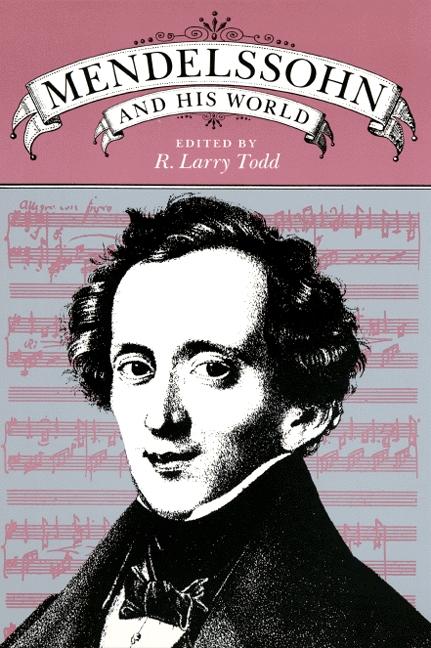
During the 1830s and 1840s the remarkably versatile composer-pianist-organist-conductor Felix Mendelssohn-Bartholdy stood at the forefront of German and English musical life. Bringing together previously unpublished essays by historians and musicologists, reflections on Mendelssohn written by his contemporaries, the composer's own letters, and early critical reviews of his music, this volume explores various facets of Mendelssohn's music, his social and intellectual circles, and his career. The essays in Part I cover the nature of a Jewish identity in Mendelssohn's music (Leon Botstein); his relationship to the Berlin Singakademie (William A. Little); the role of his sister Fanny Hensel, herself a child prodigy and accomplished composer (Nancy Reich); Mendelssohn's compositional craft in the Italian Symphony and selected concert overtures (Claudio Spies); his oratorio Elijah (Martin Staehelin); his incidental music to Sophocles' Antigone (Michael P. Steinberg); his anthem "Why, O Lord, delay forever?" (David Brodbeck); and an unfinished piano sonata (R. Larry Todd). Part II presents little-known memoirs by such contemporaries as J. C. Lobe, A. B. Marx, Julius Schubring, C. E. Horsley, Max Mller, and Betty Pistor. Mendelssohn's letters are represented in Part III by his correspondence with Wilhelm von Boguslawski and Aloys Fuchs, here translated for the first time. Part IV contains late nineteenth-century critical reviews by Heinrich Heine, Franz Brendel, Friedrich Niecks, Otto Jahn, and Hans von Blow.
Pay easily by card, Klarna, Apple Pay or Google Pay. Not happy? You always have a 14-day money-back guarantee. Read more in our terms. If you have any questions, email us at hello@memmo.org.
Memmo makes studying easier – wherever you are in the world. We bring your course books and smart study tools together in one place: summaries, quizzes, podcasts and flashcards. Plus Ted, your study buddy who answers anything you wonder. Over 50,000 students already study here – built to help you learn faster and stress less.