
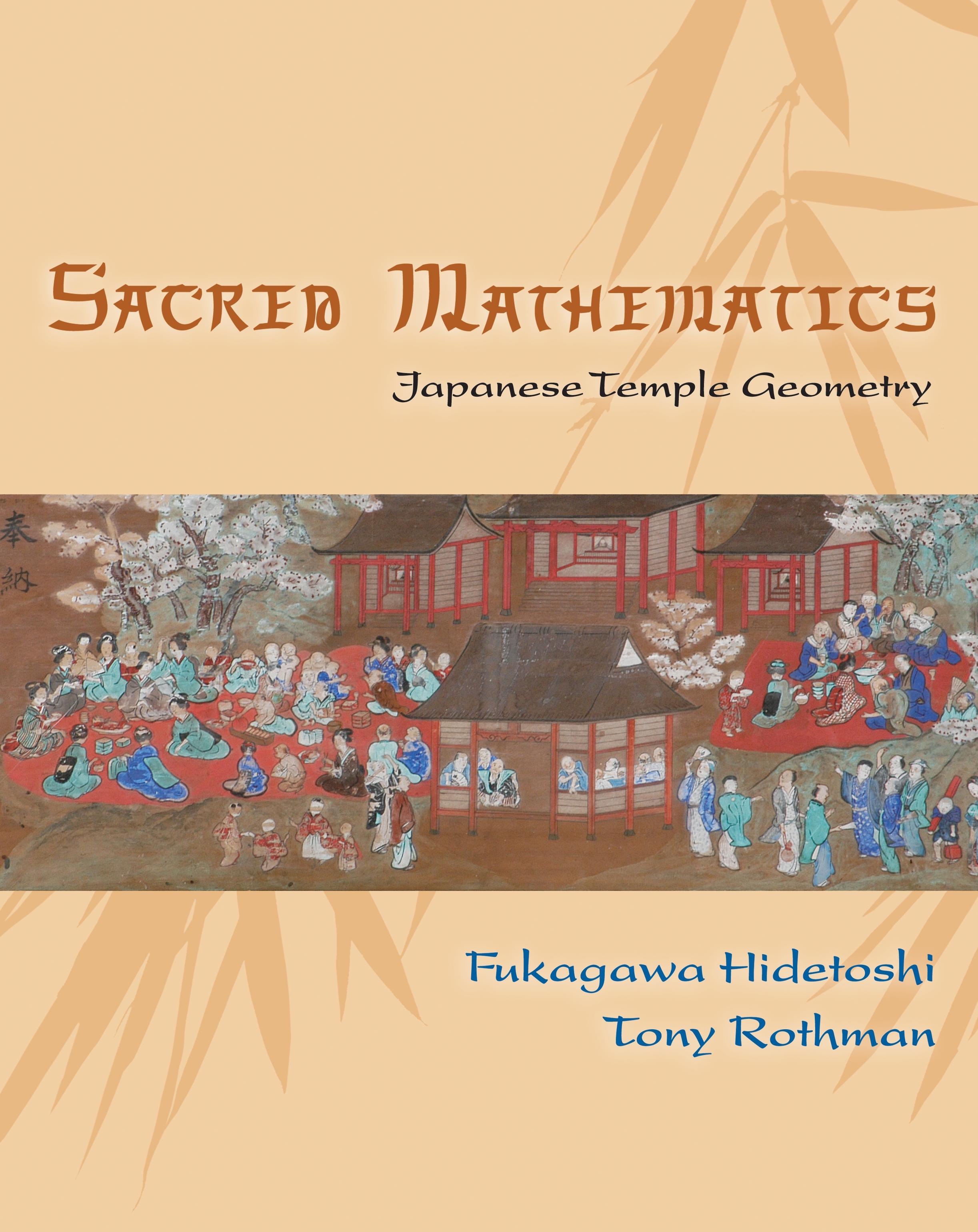
Between the seventeenth and nineteenth centuries Japan was totally isolated from the West by imperial decree. During that time, a unique brand of homegrown mathematics flourished, one that was completely uninfluenced by developments in Western mathematics. People from all walks of life--samurai, farmers, and merchants--inscribed a wide variety of geometry problems on wooden tablets called sangaku and hung them in Buddhist temples and Shinto shrines throughout Japan. Sacred Mathematics is the first book published in the West to fully examine this tantalizing--and incredibly beautiful--mathematical tradition.
Fukagawa Hidetoshi and Tony Rothman present for the first time in English excerpts from the travel diary of a nineteenth-century Japanese mathematician, Yamaguchi Kanzan, who journeyed on foot throughout Japan to collect temple geometry problems. The authors set this fascinating travel narrative--and almost everything else that is known about temple geometry--within the broader cultural and historical context of the period. They explain the sacred and devotional aspects of sangaku, and reveal how Japanese folk mathematicians discovered many well-known theorems independently of mathematicians in the West--and in some cases much earlier. The book is generously illustrated with photographs of the tablets and stunning artwork of the period. Then there are the geometry problems themselves, nearly two hundred of them, fully illustrated and ranging from the utterly simple to the virtually impossible. Solutions for most are provided.
A unique book in every respect, Sacred Mathematics demonstrates how mathematical thinking can vary by culture yet transcend cultural and geographic boundaries.
Pay easily by card, Klarna, Apple Pay or Google Pay. Not happy? You always have a 14-day money-back guarantee. Read more in our terms. If you have any questions, email us at hello@memmo.org.
Memmo makes studying easier – wherever you are in the world. We bring your course books and smart study tools together in one place: summaries, quizzes, podcasts and flashcards. Plus Ted, your study buddy who answers anything you wonder. Over 75,000 students already study here – built to help you learn faster and stress less.