
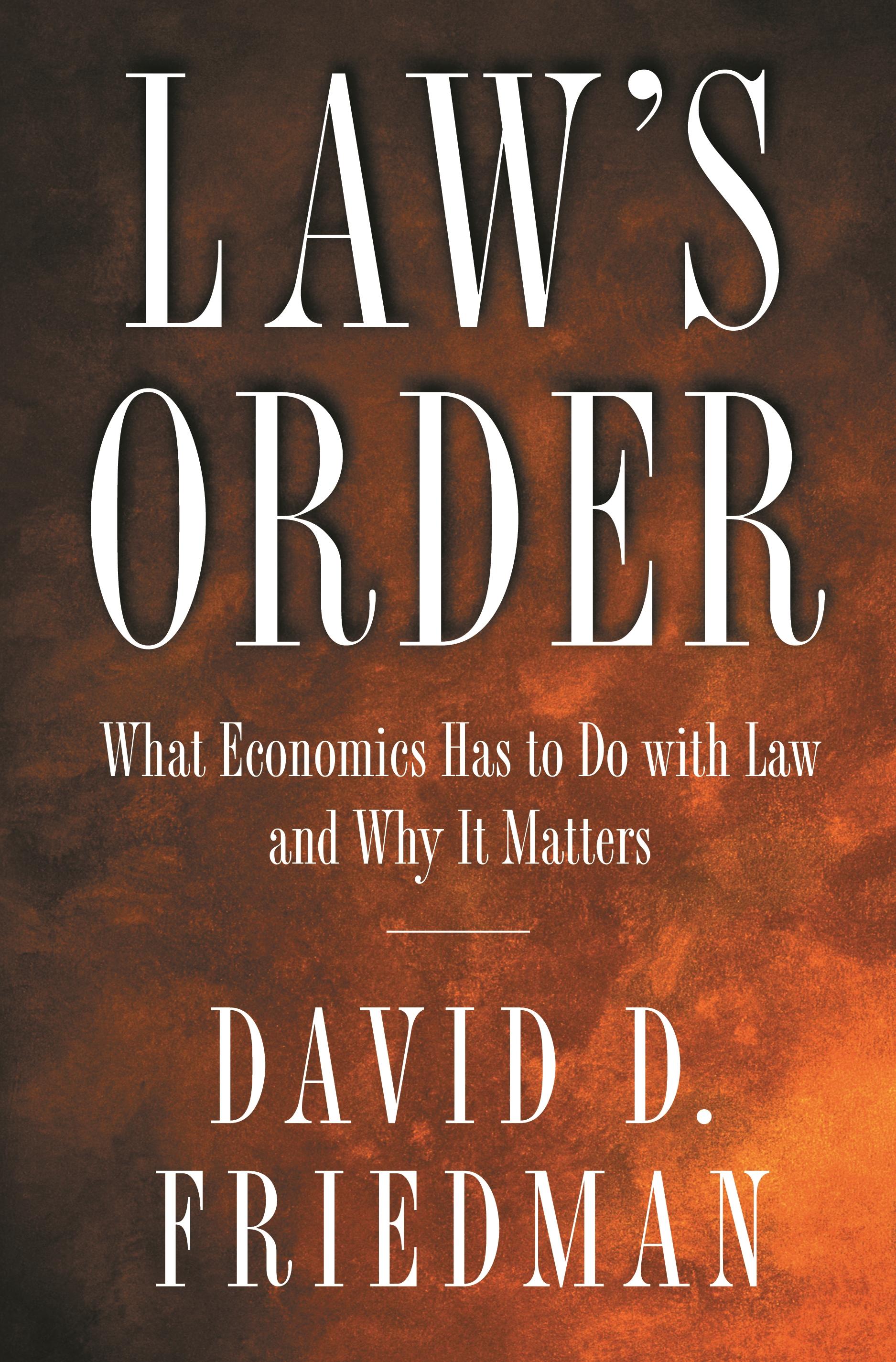
What does economics have to do with law? Suppose legislators propose that armed robbers receive life imprisonment. Editorial pages applaud them for getting tough on crime. Constitutional lawyers raise the issue of cruel and unusual punishment. Legal philosophers ponder questions of justness. An economist, on the other hand, observes that making the punishment for armed robbery the same as that for murder encourages muggers to kill their victims. This is the cut-to-the-chase quality that makes economics not only applicable to the interpretation of law, but beneficial to its crafting.
Drawing on numerous commonsense examples, in addition to his extensive knowledge of Chicago-school economics, David D. Friedman offers a spirited defense of the economic view of law. He clarifies the relationship between law and economics in clear prose that is friendly to students, lawyers, and lay readers without sacrificing the intellectual heft of the ideas presented. Friedman is the ideal spokesman for an approach to law that is controversial not because it overturns the conclusions of traditional legal scholars--it can be used to advocate a surprising variety of political positions, including both sides of such contentious issues as capital punishment--but rather because it alters the very nature of their arguments. For example, rather than viewing landlord-tenant law as a matter of favoring landlords over tenants or tenants over landlords, an economic analysis makes clear that a bad law injures both groups in the long run. And unlike traditional legal doctrines, economics offers a unified approach, one that applies the same fundamental ideas to understand and evaluate legal rules in contract, property, crime, tort, and every other category of law, whether in modern day America or other times and places--and systems of non-legal rules, such as social norms, as well.
This book will undoubtedly raise the discourse on the increasingly important topic of the economics of law, giving both supporters and critics of the economic perspective a place to organize their ideas.
Pay easily by card, Klarna, Apple Pay or Google Pay. Not happy? You always have a 14-day money-back guarantee. Read more in our terms. If you have any questions, email us at hello@memmo.org.
Memmo makes studying easier – wherever you are in the world. We bring your course books and smart study tools together in one place: summaries, quizzes, podcasts and flashcards. Plus Ted, your study buddy who answers anything you wonder. Over 50,000 students already study here – built to help you learn faster and stress less.