
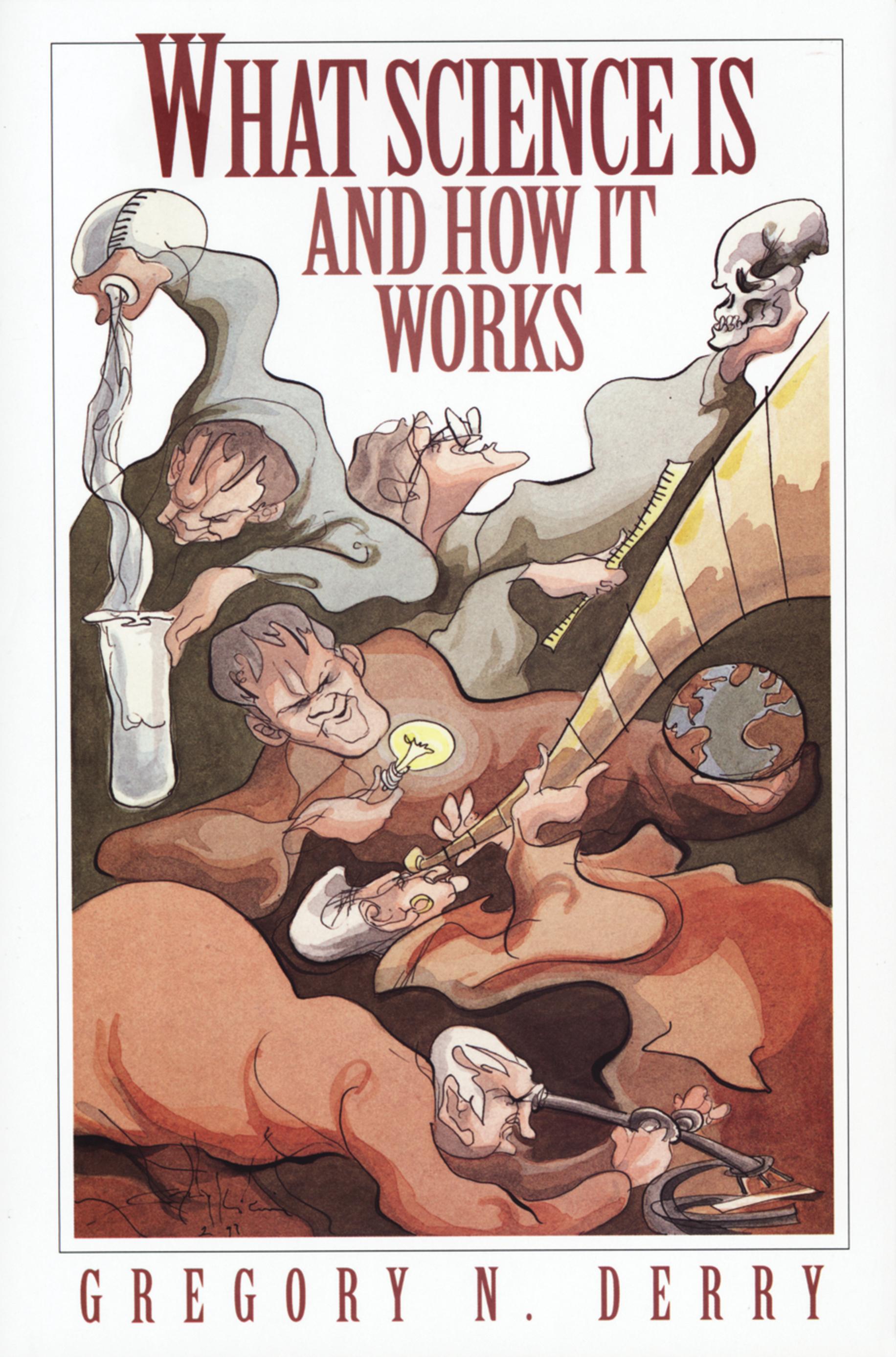
How does a scientist go about solving problems? How do scientific discoveries happen? Why are cold fusion and parapsychology different from mainstream science? What is a scientific worldview? In this lively and wide-ranging book, Gregory Derry talks about these and other questions as he introduces the reader to the process of scientific thinking. From the discovery of X rays and semiconductors to the argument for continental drift to the invention of the smallpox vaccine, scientific work has proceeded through honest observation, critical reasoning, and sometimes just plain luck. Derry starts out with historical examples, leading readers through the events, experiments, blind alleys, and thoughts of scientists in the midst of discovery and invention. Readers at all levels will come away with an enriched appreciation of how science operates and how it connects with our daily lives.
An especially valuable feature of this book is the actual demonstration of scientific reasoning. Derry shows how scientists use a small number of powerful yet simple methods--symmetry, scaling, linearity, and feedback, for example--to construct realistic models that describe a number of diverse real-life problems, such as drug uptake in the body, the inner workings of atoms, and the laws of heredity.
Science involves a particular way of thinking about the world, and Derry shows the reader that a scientific viewpoint can benefit most personal philosophies and fields of study. With an eye to both the power and limits of science, he explores the relationships between science and topics such as religion, ethics, and philosophy. By tackling the subject of science from all angles, including the nuts and bolts of the trade as well as its place in the overall scheme of life, the book provides a perfect place to start thinking like a scientist.
Pay easily by card, Klarna, Apple Pay or Google Pay. Not happy? You always have a 14-day money-back guarantee. Read more in our terms. If you have any questions, email us at hello@memmo.org.
Memmo makes studying easier – wherever you are in the world. We bring your course books and smart study tools together in one place: summaries, quizzes, podcasts and flashcards. Plus Ted, your study buddy who answers anything you wonder. Over 50,000 students already study here – built to help you learn faster and stress less.