
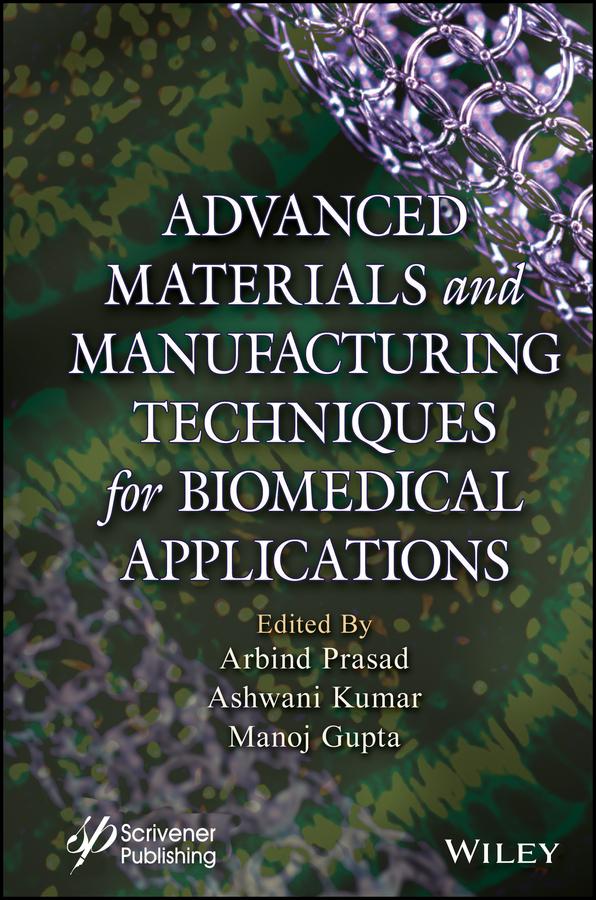
ADVANCED MATERIALS and MANUFACTURING TECHNIQUES for BIOMEDICAL APPLICATIONS
The book provides essential knowledge for the synthesis of biomedical products, development, nanomaterial properties, fabrication processes, and design techniques for different applications, as well as process design and optimization.
In origin, biomaterials can come from nature or be synthesized in the laboratory with a variety of approaches that use metals, polymers, ceramic, or composite materials. They are often used or adapted for various biomedical applications. Biomaterials are commonly used in scaffolds, orthopedic, wound healing, fracture fixation, surgical sutures, artificial organ developments, pins and screws to stabilize fractures, surgical mesh, breast implants, artificial ligaments and tendons, and drug delivery systems.
The sixteen chapters in Advanced Materials and Manufacturing Techniques in Biomedical Applications cover the synthesis, processing, design, manufacturing, and characterization of advanced materials; self-healing, bioinspired, nature-resourced, nanobiomaterials for biomedical applications; and manufacturing techniques such as rapid prototyping, additive manufacturing, etc.
Audience
The book is for engineers, technologists, and researchers working in the area of biomedical engineering and manufacturing techniques. It is also appropriate for upper-level undergraduate and graduate students.
Pay easily by card, Klarna, Apple Pay or Google Pay. Not happy? You always have a 14-day money-back guarantee. Read more in our terms. If you have any questions, email us at hello@memmo.org.
Memmo makes studying easier – wherever you are in the world. We bring your course books and smart study tools together in one place: summaries, quizzes, podcasts and flashcards. Plus Ted, your study buddy who answers anything you wonder. Over 50,000 students already study here – built to help you learn faster and stress less.