
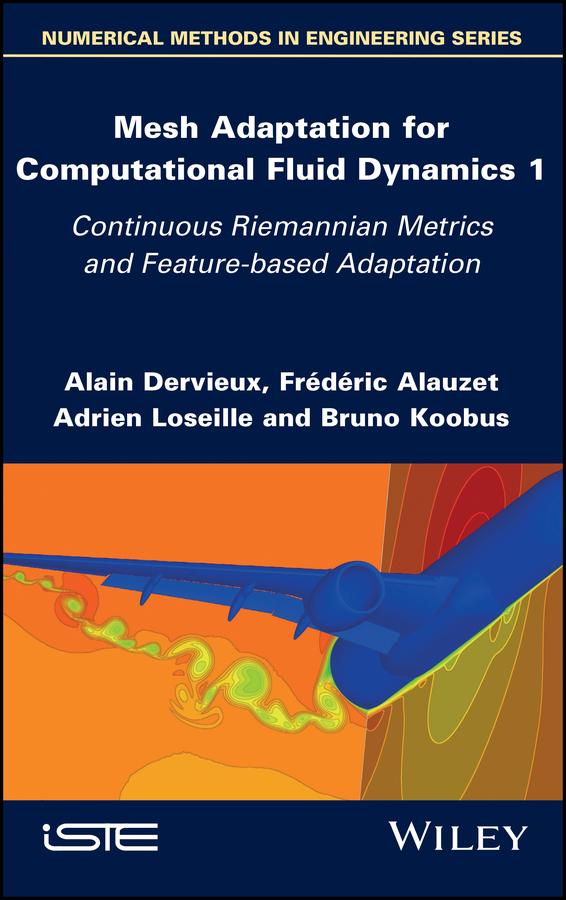
Simulation technology, and computational fluid dynamics (CFD) in particular, is essential in the search for solutions to the modern challenges faced by humanity. Revolutions in CFD over the last decade include the use of unstructured meshes, permitting the modeling of any 3D geometry. New frontiers point to mesh adaptation, allowing not only seamless meshing (for the engineer) but also simulation certification for safer products and risk prediction.
Mesh Adaptation for Computational Dynamics 1 is the first of two volumes and introduces basic methods such as feature-based and multiscale adaptation for steady models. Also covered is the continuous Riemannian metrics formulation which models the optimally adapted mesh problem into a pure partial differential statement. A number of mesh adaptative methods are defined based on a particular feature of the simulation solution.
This book will be useful to anybody interested in mesh adaptation pertaining to CFD, especially researchers, teachers and students.
Pay easily by card, Klarna, Apple Pay or Google Pay. Not happy? You always have a 14-day money-back guarantee. Read more in our terms. If you have any questions, email us at hello@memmo.org.
Memmo makes studying easier – wherever you are in the world. We bring your course books and smart study tools together in one place: summaries, quizzes, podcasts and flashcards. Plus Ted, your study buddy who answers anything you wonder. Over 50,000 students already study here – built to help you learn faster and stress less.