
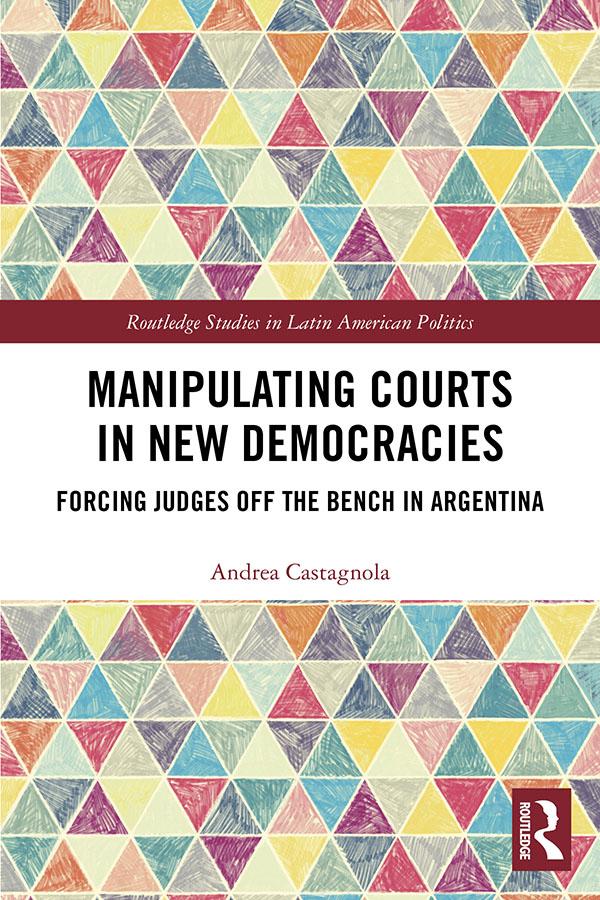
When can the Executive manipulate the composition of a Court? What political factors explain judicial instability on the bench?
Using original field data from Argentina's National Supreme Court and all twenty-four Provincial Supreme Courts, Andrea Castagnola develops a novel theory to explain forced retirements of judges. She argues that in developing democracies the political benefits of manipulating the court outweigh the costs associated with doing so. The instability of the political context and its institutions causes politicians to focus primarily on short-term goals and to care mostly about winning elections. Consequently, judiciaries become a valuable tool for politicians to have under their control.
Contrary to the predictions of strategic retirement theory, Castagnola demonstrates that there are various institutional and non-institutional mechanisms for induced retirement which politicians have used against justices, regardless of the amount of support their party has in Congress. The theoretical innovations contained herein shed much needed light on the existing literature on judicial politics and democratization. Even though the political manipulation of courts is a worldwide phenomenon, previous studies have shown that Argentina is the theory-generating case for studying manipulation of high courts.
Pay easily by card, Klarna, Apple Pay or Google Pay. Not happy? You always have a 14-day money-back guarantee. Read more in our terms. If you have any questions, email us at hello@memmo.org.
Memmo makes studying easier – wherever you are in the world. We bring your course books and smart study tools together in one place: summaries, quizzes, podcasts and flashcards. Plus Ted, your study buddy who answers anything you wonder. Over 50,000 students already study here – built to help you learn faster and stress less.