
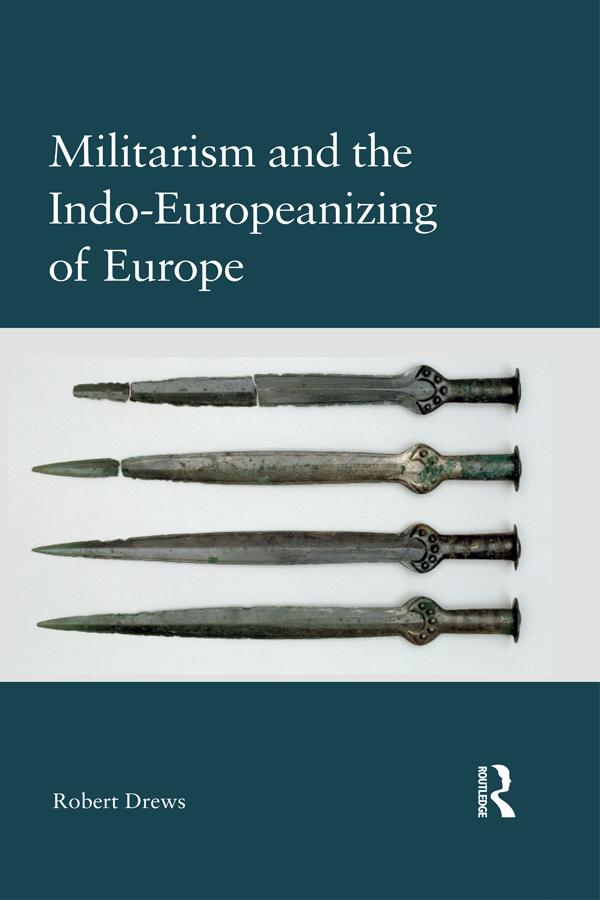
This book argues that the Indo-Europeanizing of Europe essentially began shortly before 1600 BC, when lands rich in natural resources were taken over by military forces from the Eurasian steppe and from southern Caucasia. First were the copper and silver mines (along with good harbors) in Greece, and the copper and gold mines of the Carpathian basin. By ca. 1500 BC other military men had taken over the amber coasts of Scandinavia and the metalworking district of the southern Alps. These military takeovers offer the most likely explanations for the origins of the Greek, Keltic, Germanic and Italic subgroups of the Indo-European language family.
Battlefield warfare and militarism, Robert Drews contends, were novelties ca. 1600 BC and were a consequence of the military employment of chariots. Current opinion is that militarism and battlefield warfare are as old as formal states, going back before 3000 BC.
Another current opinion is that the Indo-Europeanizing of Europe happened long before 1600 BC. The "Kurgan theory" of Marija Gimbutas and David Anthony dates it from late in the fifth to early in the third millennium BC and explains it as the result of horse-riding conquerors or raiders coming to Europe from the steppe. Colin Renfrew’s Archaeology and Language dates the Indo-Europeanizing of Europe to the seventh and sixth millennia BC, and explains it as a consequence of the spread of agriculture in a "wave of advance" from Anatolia through Europe. Pairing linguistic with archaeological evidence Drews concludes that in Greece and Italy, at least, no Indo-European language could have arrived before the second millennium BC.
Pay easily by card, Klarna, Apple Pay or Google Pay. Not happy? You always have a 14-day money-back guarantee. Read more in our terms. If you have any questions, email us at hello@memmo.org.
Memmo makes studying easier – wherever you are in the world. We bring your course books and smart study tools together in one place: summaries, quizzes, podcasts and flashcards. Plus Ted, your study buddy who answers anything you wonder. Over 75,000 students already study here – built to help you learn faster and stress less.