
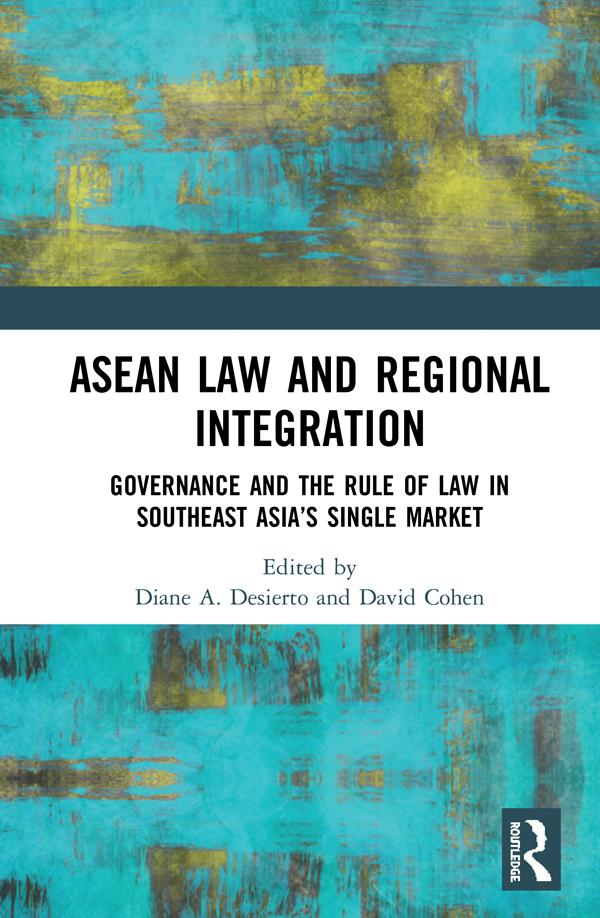
Since the passage of the ASEAN Charter in 2008, ASEAN has transformed itself from a loose economic cooperation, into a formal intergovernmental organization designed to create an “ASEAN Community” forged together in three pillar communities – the ASEAN Political-Security Community, ASEAN Economic Community, and tASEAN Socio-Cultural Community. Forty years of pre-Charter ASEAN practices, coupled with over ten years of post-Charter ASEAN practices thus far, has witnessed the conclusion of hundreds of legally binding regional treaties and similarly binding international instruments in all areas of economic, political-security, and socio-cultural concerns for Southeast Asia to achieve ASEAN’s rule of law-based development objective. Pre-Charter and post-Charter ASEAN Law is variably implemented under a hybrid governance system that depends heavily on ASEAN Member State national implementation alongside ASEAN’s evolving regional institutions. The result is not a model of deep integration as in the case of the European Union, but a particular paradigm of horizontal embeddedness of ASEAN Law – in all its norms and operational practices – contingent on the capacities and compliance of national government bureaucracies in Southeast Asia.
This edited collection is a concise authoritative volume covering the practical, doctrinal, legal, and policy aspects of the new regime of ASEAN Law and its consequences for realizing rule of law-based development in Southeast Asia’s emerging single market and production base. Drawing together contributions from a range of key thinkers in the field, the editors present the legal and policy-making issues implicated in the practical implementation of Southeast Asia’s single market and its regime for the free movement of goods, services, foreign investment, and cross-border labor. The book also examines the nature of regional law-making under ASEAN before and after the commencement of regional integration in 2015, the nature of ASEAN’s economic regulators, as well as the evolving structure for enforcement and harmonization of “ASEAN Law” through the array of Southeast Asian national courts, arbitral tribunals, and incipient mechanisms for inter-State, intra-regional, and individual-State conflict management and dispute resolution.
This book is highly relevant to students, scholars, and policy-makers with an interest in ASEAN Law and regional policy, and to Southeast Asian studies in general.
Pay easily by card, Klarna, Apple Pay or Google Pay. Not happy? You always have a 14-day money-back guarantee. Read more in our terms. If you have any questions, email us at hello@memmo.org.
Memmo makes studying easier – wherever you are in the world. We bring your course books and smart study tools together in one place: summaries, quizzes, podcasts and flashcards. Plus Ted, your study buddy who answers anything you wonder. Over 50,000 students already study here – built to help you learn faster and stress less.