
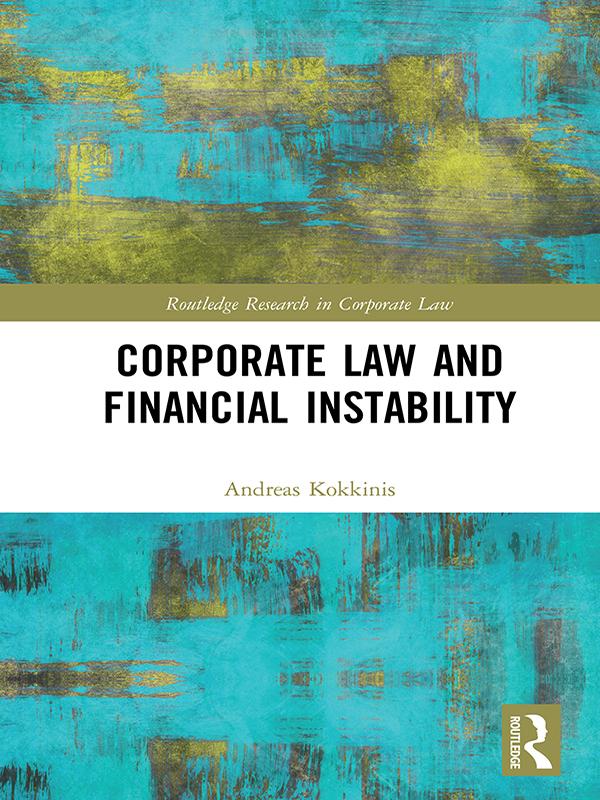
Virtually all large banks and other financial institutions in the UK and internationally are public limited liability companies whose shares are listed on one or several stock exchanges. As such, their corporate governance and, in particular, the incentives faced by their directors and senior managers are to a significant extent determined by corporate and securities law rules such as directors’ duties, directors’ liability in insolvency, takeover regulation, disclosure obligations, shareholder rights and rules on executive remuneration. At the same time, systemically important financial institutions in the UK are licensed, regulated and supervised by the Prudential Regulation Authority (PRA).
This book explores the relationship between, on the one hand, the broader corporate law, corporate governance and securities law framework and, on the other, the prudential regulatory framework. Although the book’s main focus is on UK law, much of the policy argumentation is relevant globally and therefore appropriate international comparisons are drawn, and analysis of EU law and regulation is included. The book argues that the corporate law regime, which focuses on shareholder empowerment and profit maximisation, operates as an antithesis to prudential regulatory objectives thus undermining the safety and soundness of banks and other financial institutions by encouraging risky behaviour that may be in the best interests of their shareholders, but is clearly not in the public interest.
Pay easily by card, Klarna, Apple Pay or Google Pay. Not happy? You always have a 14-day money-back guarantee. Read more in our terms. If you have any questions, email us at hello@memmo.org.
Memmo makes studying easier – wherever you are in the world. We bring your course books and smart study tools together in one place: summaries, quizzes, podcasts and flashcards. Plus Ted, your study buddy who answers anything you wonder. Over 50,000 students already study here – built to help you learn faster and stress less.