
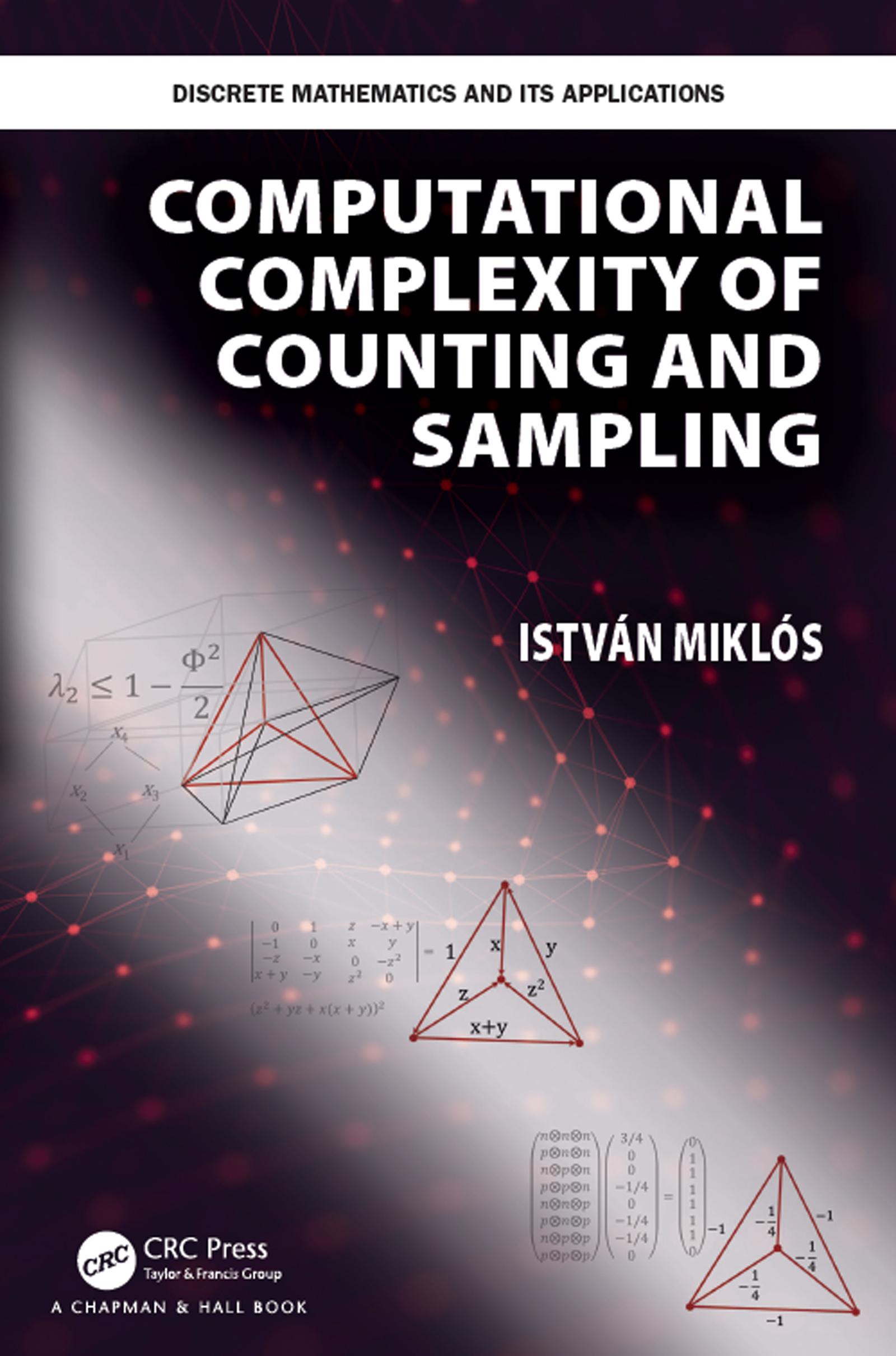
Computational Complexity of Counting and Sampling provides readers with comprehensive and detailed coverage of the subject of computational complexity. It is primarily geared toward researchers in enumerative combinatorics, discrete mathematics, and theoretical computer science.
The book covers the following topics: Counting and sampling problems that are solvable in polynomial running time, including holographic algorithms; #P-complete counting problems; and approximation algorithms for counting and sampling.
First, it opens with the basics, such as the theoretical computer science background and dynamic programming algorithms. Later, the book expands its scope to focus on advanced topics, like stochastic approximations of counting discrete mathematical objects and holographic algorithms. After finishing the book, readers will agree that the subject is well covered, as the book starts with the basics and gradually explores the more complex aspects of the topic.
Features:
- Each chapter includes exercises and solutions
- Ideally written for researchers and scientists
- Covers all aspects of the topic, beginning with a solid introduction, before shifting to computational complexity’s more advanced features, with a focus on counting and sampling
Pay easily by card, Klarna, Apple Pay or Google Pay. Not happy? You always have a 14-day money-back guarantee. Read more in our terms. If you have any questions, email us at hello@memmo.org.
Memmo makes studying easier – wherever you are in the world. We bring your course books and smart study tools together in one place: summaries, quizzes, podcasts and flashcards. Plus Ted, your study buddy who answers anything you wonder. Over 75,000 students already study here – built to help you learn faster and stress less.