
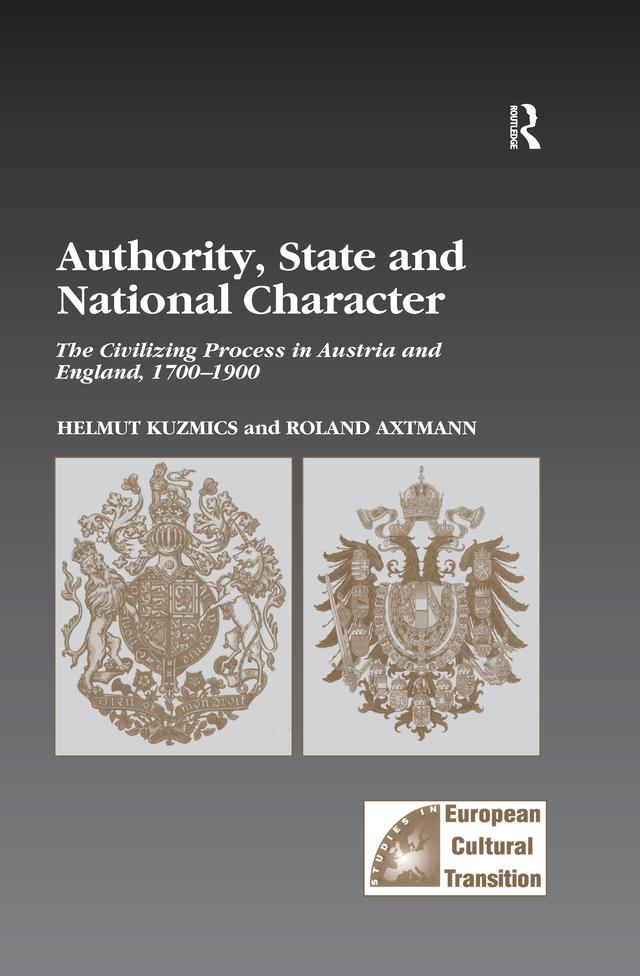
This book presents a cross-disciplinary and methodologically innovative study, combining historical macro-sociology and a sociology of emotions with historical anthropology and cultural studies. Drawing on the concepts and theories of Norbert Elias on the Civilizing Process, it sets out to pin down and compare qualities that are simultaneously instantly recognisable and highly elusive, that is a kind of typical 'Englishness' and of 'Austrianness' that developed contemporaneously in the period up to the First World War. The authors chart the development of political authority structures in their varied historical manifestations, as well as their affective sedimentation as collective habitus ( national character ), comparing England and Austria from 1700 to 1900 as a case study. Their argument is based on an analysis of literary sources, mainly novels and plays, applying a sociology of literature approach. Axtmann and Kuzmics argue that the very different national characters formed in England and Austria during this time are related to differences in the affective experience of power and powerlessness, in short, of authority. They show that the formation of national character is determined partly by the different mixture of authoritative external constraints and milder self-restraint, and partly by the affective experience of human beings in uneven power balances. Specifically, they show how the formation of the bureaucratic state with strong patrimonial features in Austria, and of a self-organizing civil society with strong bourgeois-liberal features in England resulted both in different institutional structures of authority, and in different modes of the affective experience of this authority. Employing empirical detail of individual cases and texts to analyse and illuminate broad processes, the authors reach a clearer and deeper understanding of seemingly intangible and irrational aspects of national identity.
Pay easily by card, Klarna, Apple Pay or Google Pay. Not happy? You always have a 14-day money-back guarantee. Read more in our terms. If you have any questions, email us at hello@memmo.org.
Memmo makes studying easier – wherever you are in the world. We bring your course books and smart study tools together in one place: summaries, quizzes, podcasts and flashcards. Plus Ted, your study buddy who answers anything you wonder. Over 50,000 students already study here – built to help you learn faster and stress less.
You might also like
Buy the book0