
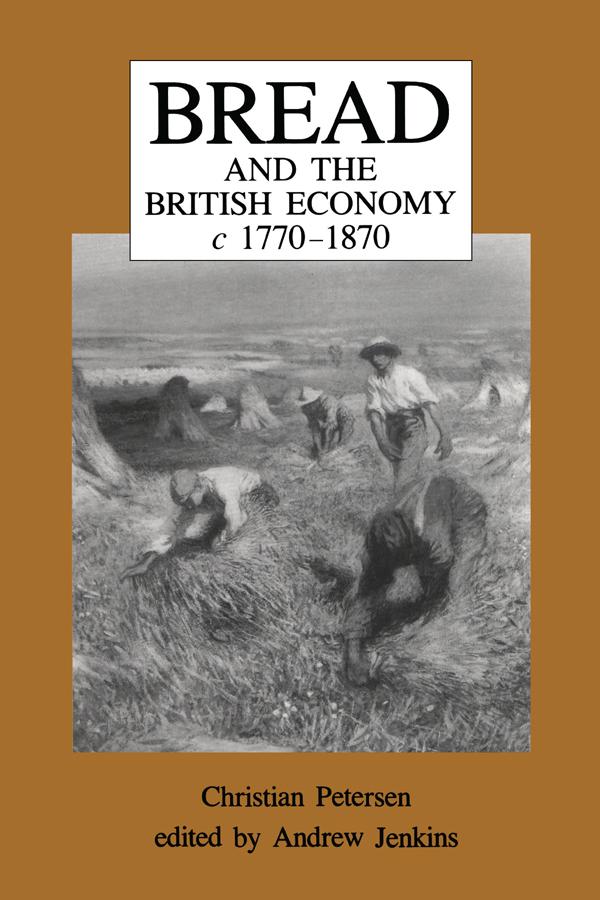
In this ambitious book Christian Petersen has taken a central topic in economic and social history and given it a new sweep and coherence. As the Lord’s Prayer suggests, securing an adequate supply of bread was a matter of over-riding concern to everyone until very recently. Bread was always by far the largest single item in the budgets of the poor, but bread could be made from many grains - wheat, rye, barley etc. Christian Petersen describes how in the later eighteenth century the process of replacing other cereals by wheat in bread making was completed throughout Britain. He provides a continuous series of estimates of bread consumption per caput, of bread prices (and, consequently, used in conjunction with population data, of total national expenditure on bread), and of wheat output and net imports. The implications of the changes in techniques of milling and baking that occurred are analysed, and the organisation of the baking and retailing of bread is described. Bread was so central to the economy of individual households and to the national economy as a whole that this book represents a major contribution to the history of the British economy and of British society in the period 1770-1870.
Pay easily by card, Klarna, Apple Pay or Google Pay. Not happy? You always have a 14-day money-back guarantee. Read more in our terms. If you have any questions, email us at hello@memmo.org.
Memmo makes studying easier – wherever you are in the world. We bring your course books and smart study tools together in one place: summaries, quizzes, podcasts and flashcards. Plus Ted, your study buddy who answers anything you wonder. Over 50,000 students already study here – built to help you learn faster and stress less.
You might also like
Buy the book0