
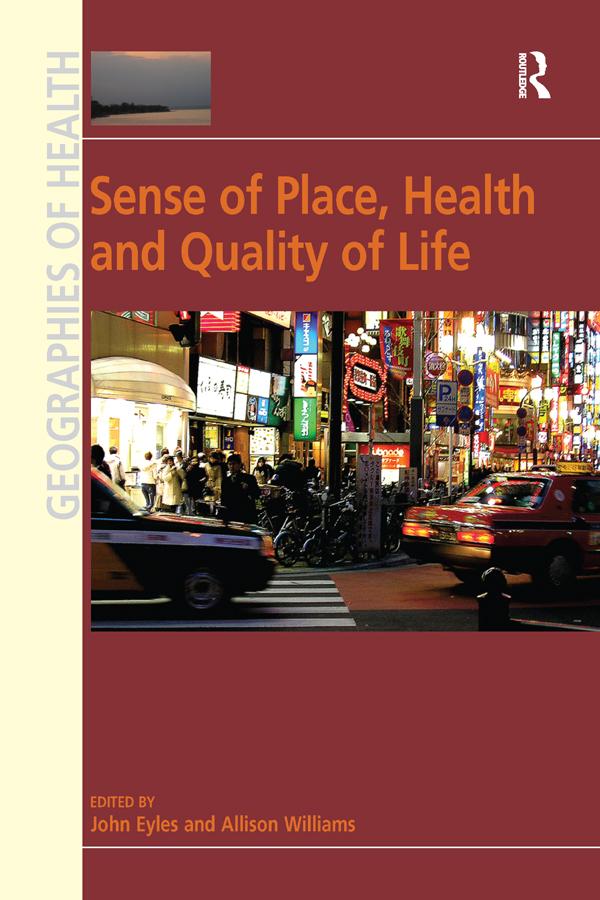
A significant body of theoretical and empirical studies describes 'sense of place' as an outcome of interconnected psychological, social and environmental processes in relation to physical place(s). Sense of place has been examined, particularly in human geography, in terms of both the character intrinsic to a place as a localized, bounded and material entity, and the sentiments of attachment/detachment that humans experience and express in relation to specific places. Scholars in a wide range of disciplines are increasingly exploring the relationship between place and health, and recently, the field of public health has been encouraged to recognize sense of place as a potential contributing factor to well-being. It is evident that over the last few decades, sense of place has developed into a versatile construct. This important book brings together work related to sense of place and health, broadly defined, from the perspective of a variety of fields and disciplines. It will give the reader an understanding of both the range of applications of this construct within approaches to human health as well as the breadth of research methodologies employed in its investigation.
Pay easily by card, Klarna, Apple Pay or Google Pay. Not happy? You always have a 14-day money-back guarantee. Read more in our terms. If you have any questions, email us at hello@memmo.org.
Memmo makes studying easier – wherever you are in the world. We bring your course books and smart study tools together in one place: summaries, quizzes, podcasts and flashcards. Plus Ted, your study buddy who answers anything you wonder. Over 50,000 students already study here – built to help you learn faster and stress less.
You might also like
Buy the book0