
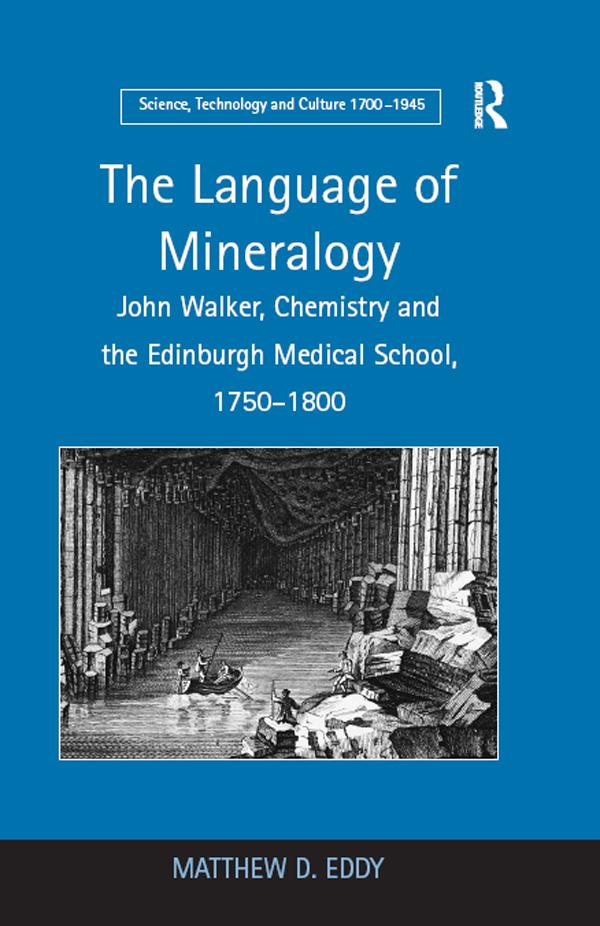
Classification is an important part of science, yet the specific methods used to construct Enlightenment systems of natural history have proven to be the bête noir of studies of eighteenth-century culture. One reason that systematic classification has received so little attention is that natural history was an extremely diverse subject which appealed to a wide range of practitioners, including wealthy patrons, professionals, and educators. In order to show how the classification practices of a defined institutional setting enabled naturalists to create systems of natural history, this book focuses on developments at Edinburgh's medical school, one of Europe's leading medical programs. In particular, it concentrates on one of Scotland's most influential Enlightenment naturalists, Rev Dr John Walker, the professor of natural history at the school from 1779 to 1803. Walker was a traveller, cleric, author and advisor to extremely powerful aristocratic and government patrons, as well as teacher to hundreds of students, some of whom would go on to become influential industrialists, scientists, physicians and politicians. This book explains how Walker used his networks of patrons and early training in chemistry to become an eighteenth-century naturalist. Walker's mineralogy was based firmly in chemistry, an approach common in Edinburgh's medical school, but a connection that has been generally overlooked in the history of British geology. By explicitly connecting eighteenth-century geology to the chemistry being taught in medical settings, this book offers a dynamic new interpretation of the nascent earth sciences as they were practiced in Enlightenment Britain. Because of Walker's influence on his many students, the book also provides a unique insight into how many of Britain's leading Regency and Victorian intellectuals were taught to think about the composition and structure of the material world.
Pay easily by card, Klarna, Apple Pay or Google Pay. Not happy? You always have a 14-day money-back guarantee. Read more in our terms. If you have any questions, email us at hello@memmo.org.
Memmo makes studying easier – wherever you are in the world. We bring your course books and smart study tools together in one place: summaries, quizzes, podcasts and flashcards. Plus Ted, your study buddy who answers anything you wonder. Over 50,000 students already study here – built to help you learn faster and stress less.
You might also like
Buy the book0