
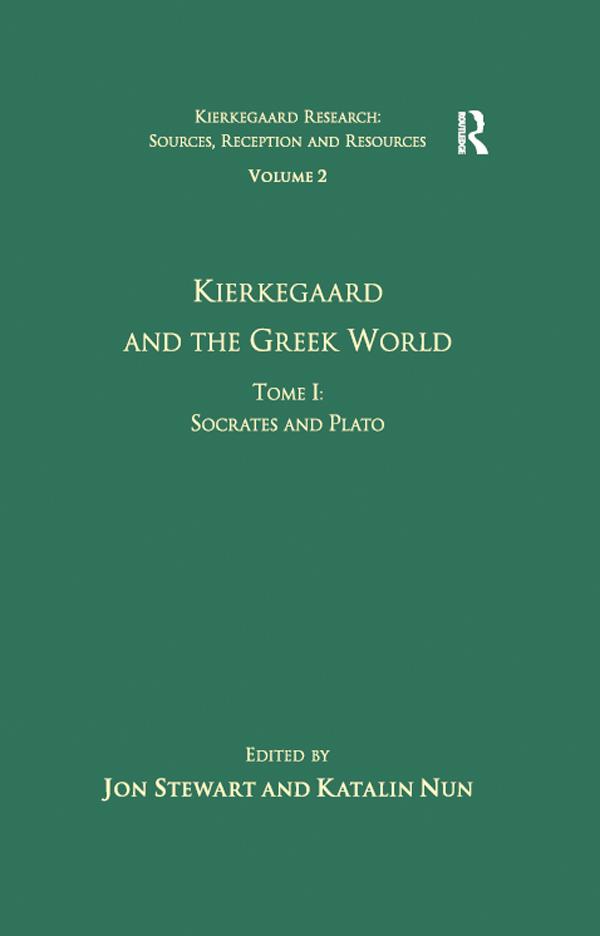
The articles in this volume employ source-work research to trace Kierkegaard's understanding and use of authors from the Greek tradition. A series of figures of varying importance in Kierkegaard's authorship are treated, ranging from early Greek poets to late Classical philosophical schools. In general it can be said that the Greeks collectively constitute one of the single most important body of sources for Kierkegaard's thought. He studied Greek from an early age and was profoundly inspired by what might be called the Greek spirit. Although he is generally considered a Christian thinker, he was nonetheless consistently drawn back to the Greeks for ideas and impulses on any number of topics. He frequently contrasts ancient Greek philosophy, with its emphasis on the lived experience of the individual in daily life, with the abstract German philosophy that was in vogue during his own time. It has been argued that he modeled his work on that of the ancient Greek thinkers specifically in order to contrast his own activity with that of his contemporaries.
Pay easily by card, Klarna, Apple Pay or Google Pay. Not happy? You always have a 14-day money-back guarantee. Read more in our terms. If you have any questions, email us at hello@memmo.org.
Memmo makes studying easier – wherever you are in the world. We bring your course books and smart study tools together in one place: summaries, quizzes, podcasts and flashcards. Plus Ted, your study buddy who answers anything you wonder. Over 50,000 students already study here – built to help you learn faster and stress less.
You might also like
Buy the book0