
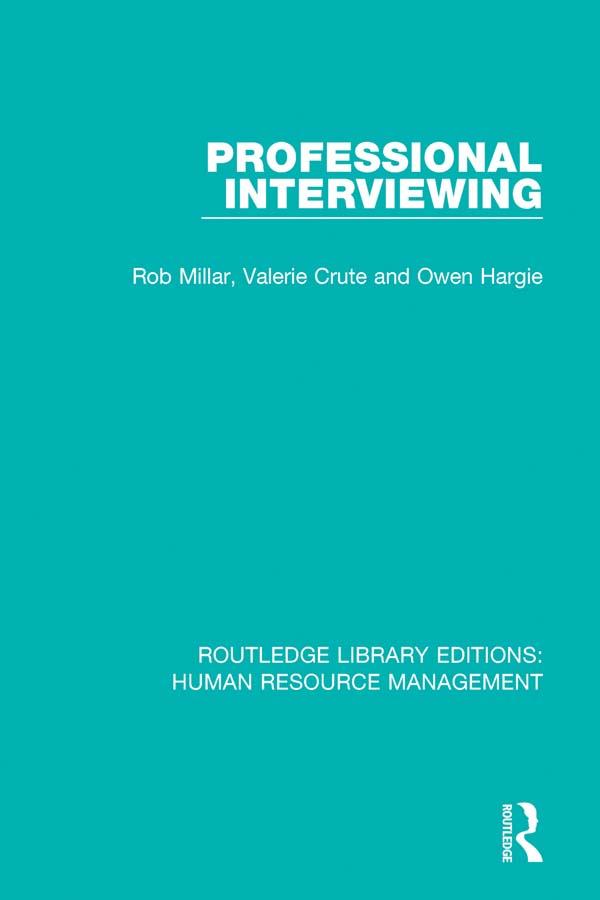
This book, first published in 1992, presents a detailed, informed and informative account of research, theory and practice in interviewing. As a single source for practitioners, it focuses on the professional practice of interviewing as a strategy for achieving specific objectives. As well as providing reviews of recent research in interviewing, it includes practical examples of interviewing in many different contexts.
The authors, all of whom have wide experience of interviewing, draw on a wealth of information and insight acquired during their work. They examine the definitions and purposes of interviewing and then describe the main settings within which it takes place - counselling, selection, research, medical and appraisal. Taking a social interactional model of interviewing, they discuss the main components of the activity: person perception; interviewer goals; interview structures and stages; effective interviewing skills; and the interviewee's perspective on the interview process. Examples are used to illustrate particular issues and to highlight their relevance to practice. The authors also consider important ethical and professional problems which may crucially affect the practice of interviewing.
This book should be of interest to professionals and students in psychology, health, counselling, human resource management and business.
Pay easily by card, Klarna, Apple Pay or Google Pay. Not happy? You always have a 14-day money-back guarantee. Read more in our terms. If you have any questions, email us at hello@memmo.org.
Memmo makes studying easier – wherever you are in the world. We bring your course books and smart study tools together in one place: summaries, quizzes, podcasts and flashcards. Plus Ted, your study buddy who answers anything you wonder. Over 50,000 students already study here – built to help you learn faster and stress less.