
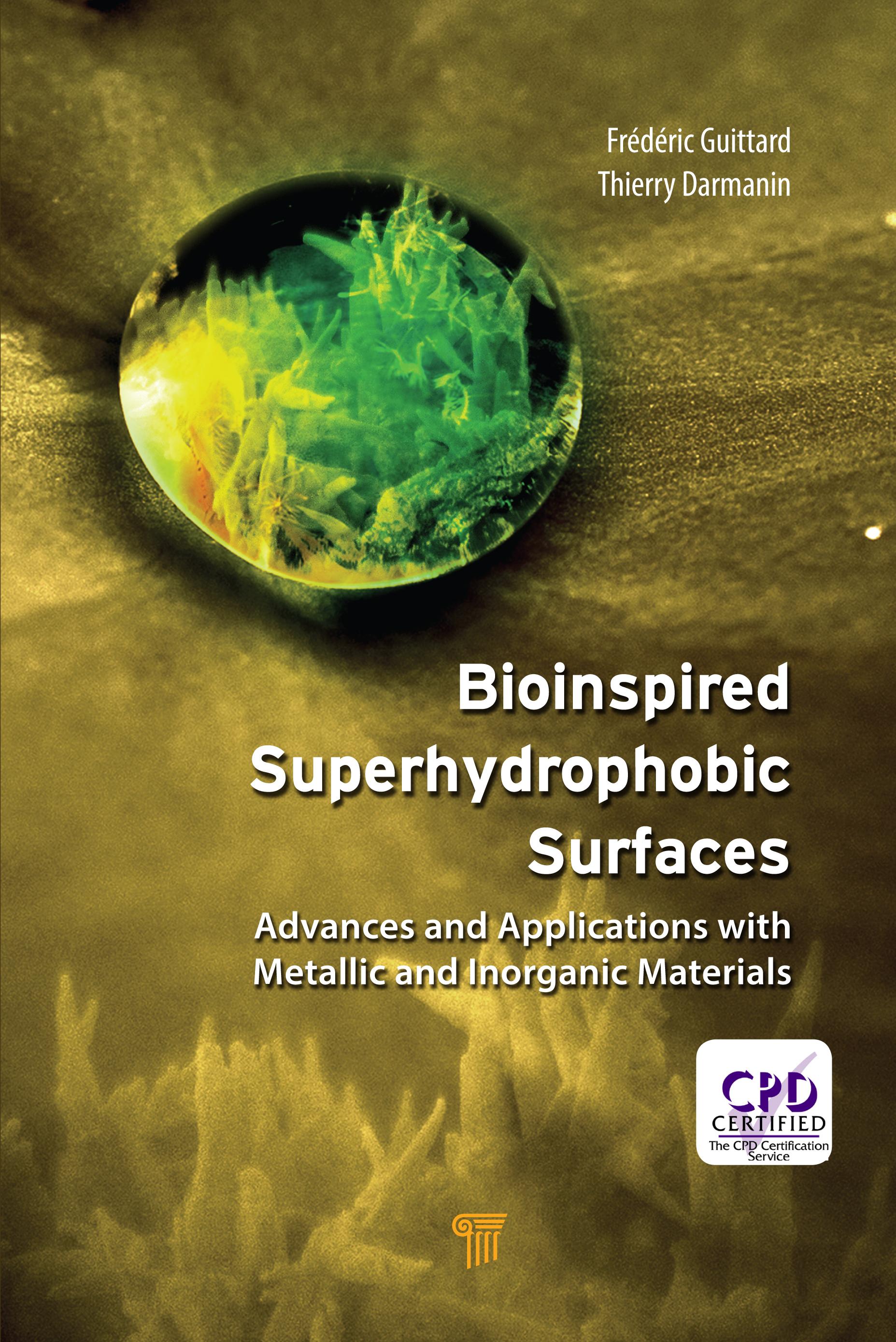
Materials with superhydrophobic or related properties are one of the most studied subjects from a theoretical point of view and also for the large range of possible applications, for example, anticorrosion, antibacteria, optical devices, and sensors. The study of natural species with special wettability has shown us the importance of surface structures and the surface energy of the resulting surface properties. Various strategies can be used to reproduce superhydrophobic phenomena in the laboratory. General reviews on superhydrophobic properties already exist but, to our knowledge, do not focus on metallic and inorganic materials. Here, we focus especially on the strategies implemented for reaching superhydrophobic or related properties using metallic and inorganic materials. Indeed, these materials present unique properties, for example, thermal and mechanical resistance, chemical and ageing resistance, and optical (transparency, antireflection, photoluminescence) and electrical properties (conducting, semiconducting, insulating).
This book will be useful for graduate students of materials chemistry and physics and for researchers in surface science, nanostructures, and bioinspired or biomimetic materials.
Pay easily by card, Klarna, Apple Pay or Google Pay. Not happy? You always have a 14-day money-back guarantee. Read more in our terms. If you have any questions, email us at hello@memmo.org.
Memmo makes studying easier – wherever you are in the world. We bring your course books and smart study tools together in one place: summaries, quizzes, podcasts and flashcards. Plus Ted, your study buddy who answers anything you wonder. Over 75,000 students already study here – built to help you learn faster and stress less.