
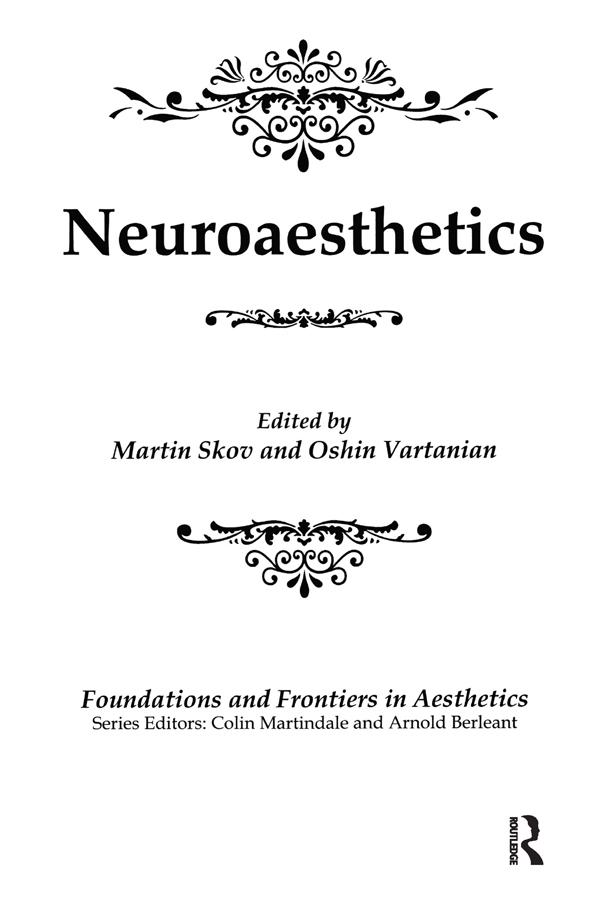
The beginning of psychological aesthetics is normally traced back to the publication of Gustav Theodor Fechner's seminal book "Vorschule der Aesthetik" in 1876. Following in the footsteps of this rich tradition, editors Martin Skov and Oshin Vartanian view neuroaesthetics - the emerging field of inquiry concerned with uncovering the ways in which aesthetic behavior is caused by brain processes - as a natural extension of Fechner's 'empirical spirit' to understand the link between the objective and subjective worlds inherent in aesthetic experience. The editors had two specific aims for this book. The first was to highlight the diversity of approaches that are underway under the banner of neuroaesthetics.Currently, this topic is being investigated from experimental, evolutionary, neuropsychological, and neuroimaging perspectives to tackle problems in the visual arts, literature, music, and film. Its quintessentially interdisciplinary nature has functioned as a breeding ground for generating and testing hypotheses in multiple domains. The second goal was more integrative and involved distilling some of the key features common to these diverse strands of work. The book presents a possible framework for neuroaesthetics by highlighting what the contributors consider to be its defining features and offering a working definition of neuroaesthetics that captures these features. "Neuroaesthetics" will provide an empirical and theoretical framework to motivate further work in this area. Ultimately, the hope is that puzzles in aesthetics can be solved through insights from biology, but that the contribution can be truly bidirectional.
Pay easily by card, Klarna, Apple Pay or Google Pay. Not happy? You always have a 14-day money-back guarantee. Read more in our terms. If you have any questions, email us at hello@memmo.org.
Memmo makes studying easier – wherever you are in the world. We bring your course books and smart study tools together in one place: summaries, quizzes, podcasts and flashcards. Plus Ted, your study buddy who answers anything you wonder. Over 50,000 students already study here – built to help you learn faster and stress less.