
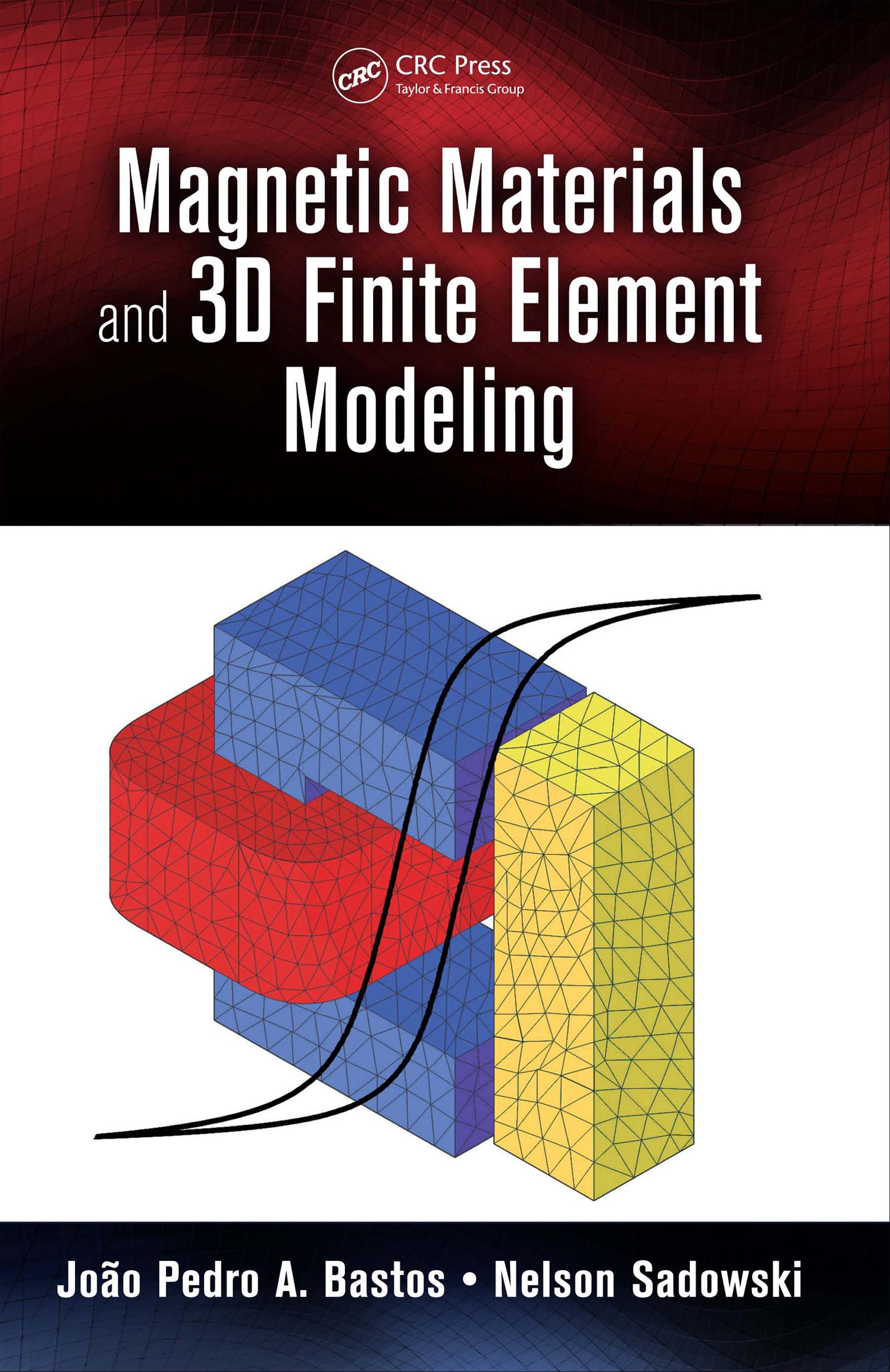
Magnetic Materials and 3D Finite Element Modeling explores material characterization and finite element modeling (FEM) applications. This book relates to electromagnetic analysis based on Maxwell’s equations and application of the finite element (FE) method to low frequency devices. A great source for senior undergraduate and graduate students in electromagnetics, it also supports industry professionals working in magnetics, electromagnetics, ferromagnetic materials science and electrical engineering.
The authors present current concepts on ferromagnetic material characterizations and losses. They provide introductory material; highlight basic electromagnetics, present experimental and numerical modeling related to losses and focus on FEM applied to 3D applications. They also explain various formulations, and discuss numerical codes.
• Furnishes algorithms in computational language
• Summarizes concepts related to the FE method
• Uses classical algebra to present the method, making it easily accessible to engineers
Written in an easy-to-understand tutorial format, the text begins with a short presentation of Maxwell’s equations, discusses the generation mechanism of iron losses, and introduces their static and dynamic components. It then demonstrates simplified models for the hysteresis phenomena under alternating magnetic fields. The book also focuses on the Preisach and Jiles–Atherton models, discusses vector hysterisis modeling, introduces the FE technique, and presents nodal and edge elements applied to 3D FE formulation connected to the hysteretic phenomena.
The book discusses the concept of source-field for magnetostatic cases, magnetodynamic fields, eddy currents, and anisotropy. It also explores the need for more sophisticated coding, and presents techniques for solving linear systems generated by the FE cases while considering advantages and drawbacks.
Pay easily by card, Klarna, Apple Pay or Google Pay. Not happy? You always have a 14-day money-back guarantee. Read more in our terms. If you have any questions, email us at hello@memmo.org.
Memmo makes studying easier – wherever you are in the world. We bring your course books and smart study tools together in one place: summaries, quizzes, podcasts and flashcards. Plus Ted, your study buddy who answers anything you wonder. Over 50,000 students already study here – built to help you learn faster and stress less.