
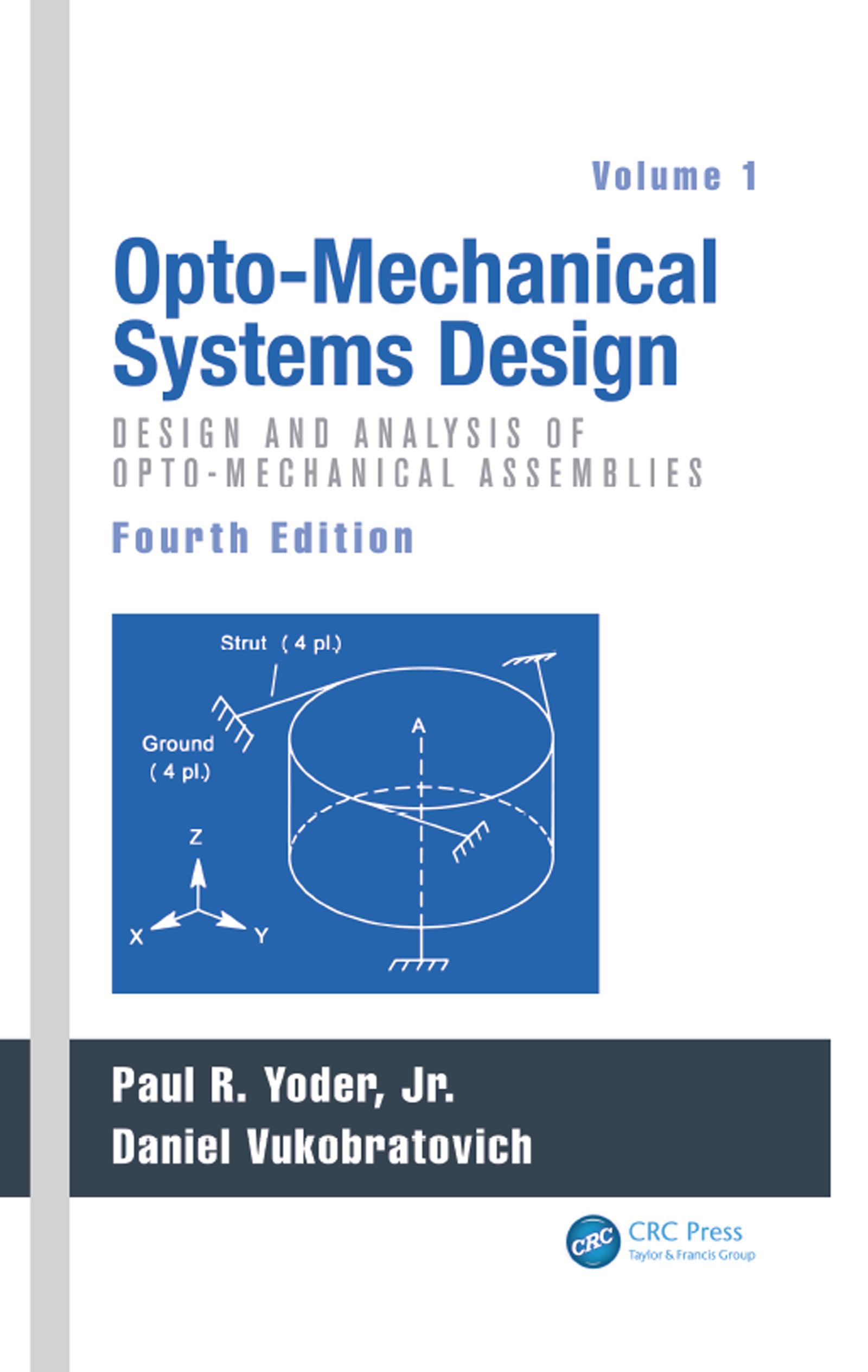
Opto-Mechanical Systems Design, Fourth Edition is different in many ways from its three earlier editions: coauthor Daniel Vukobratovich has brought his broad expertise in materials, opto-mechanical design, analysis of optical instruments, large mirrors, and structures to bear throughout the book; Jan Nijenhuis has contributed a comprehensive new chapter on kinematics and applications of flexures; and several other experts in special aspects of opto-mechanics have contributed portions of other chapters. An expanded feature—a total of 110 worked-out design examples—has been added to several chapters to show how the theory, equations, and analytical methods can be applied by the reader. Finally, the extended text, new illustrations, new tables of data, and new references have warranted publication of this work in the form of two separate but closely entwined volumes.
This first volume, Design and Analysis of Opto-Mechanical Assemblies, addresses topics pertaining primarily to optics smaller than 50 cm aperture. It summarizes the opto-mechanical design process, considers pertinent environmental influences, lists and updates key parameters for materials, illustrates numerous ways for mounting individual and multiple lenses, shows typical ways to design and mount windows and similar components, details designs for many types of prisms and techniques for mounting them, suggests designs and mounting techniques for small mirrors, explains the benefits of kinematic design and uses of flexures, describes how to analyze various types of opto-mechanical interfaces, demonstrates how the strength of glass can be determined and how to estimate stress generated in optics, and explains how changing temperature affects opto-mechanical assemblies.
Pay easily by card, Klarna, Apple Pay or Google Pay. Not happy? You always have a 14-day money-back guarantee. Read more in our terms. If you have any questions, email us at hello@memmo.org.
Memmo makes studying easier – wherever you are in the world. We bring your course books and smart study tools together in one place: summaries, quizzes, podcasts and flashcards. Plus Ted, your study buddy who answers anything you wonder. Over 50,000 students already study here – built to help you learn faster and stress less.