
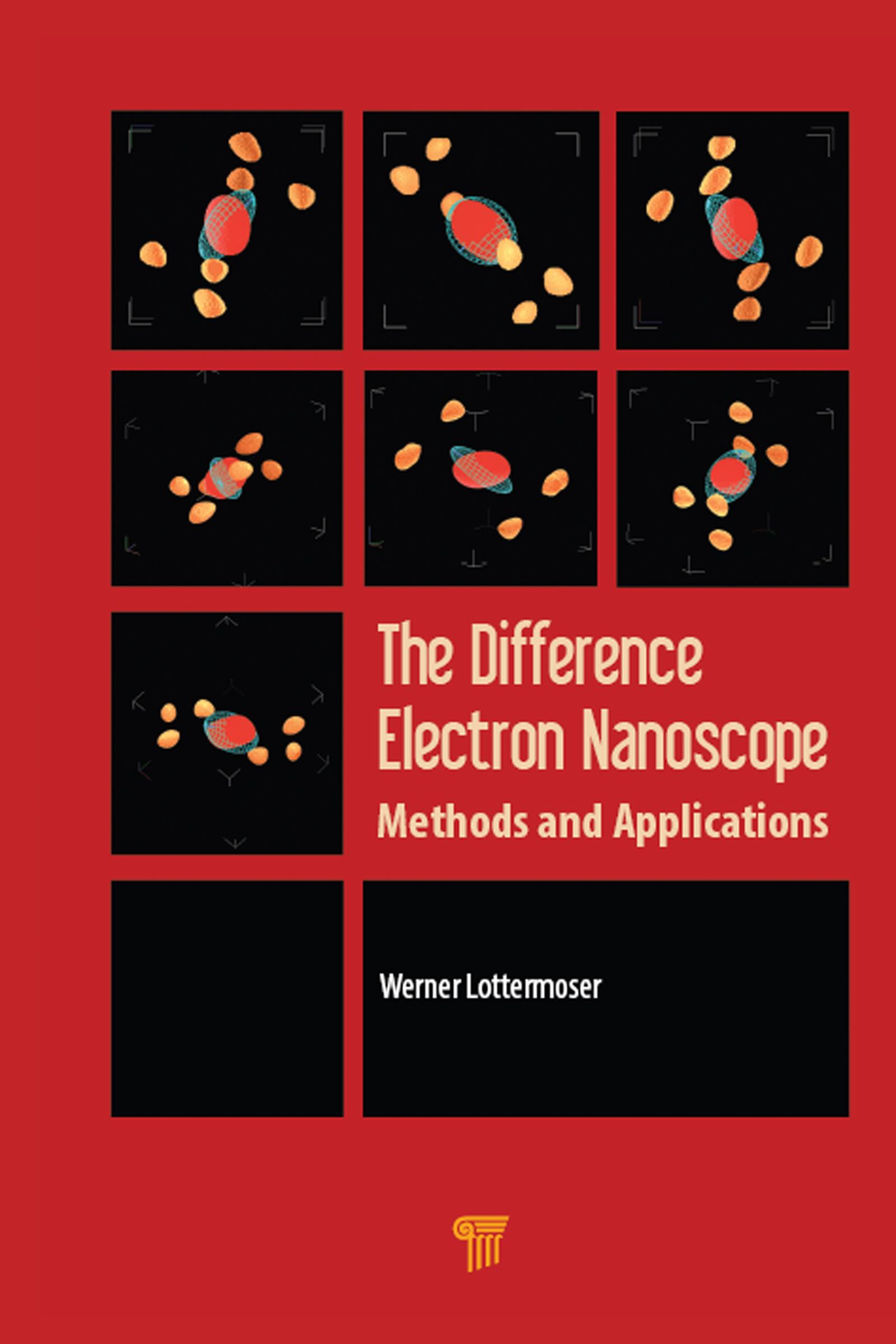
This book deals with the difference electron nanoscope (DEN), whose principles have been invented and realised by the book author. The DEN is based on a smart combination of diffractometric and spectroscopic data and uses a visualisation of three-dimensional difference electron densities (in our case stemming from 3d orbitals) in order to obtain the key quantity involved, the electric field gradient (efg). However, the DEN is no machine, as the title of the book might infer. It is a computer program running on a fast computer system displaying 3D difference electron hyperareas floating in space and the relevant efg as a wire frame model within the unit cell of the sample involved. In this sense, it acts on a sub-nanometer scale (hence the term "nanoscope") and generates images of uncompared symmetrical and physical evidence—and beauty.
For the first time, diffractometry and spectroscopy have been integrated for the common synergetic effects that may contribute to a better understanding of electric and magnetic interactions in a crystal. The experimental derivation of the common quantity, the efg, is not confined to iron-containing samples, as the use of Mössbauer spectroscopy might infer, but can also be determined by nuclear quadrupole resonance that is not confined to special nuclides. Hence, the DEN can be applied to a huge multitude of scientifically interesting specimens since the main method involved, diffractometry in a wide sense, has no general limitations at all. So it is a rather universal method, and the monograph might contribute to a wide distribution of the method in the scientific world. Has anyone seen a real orbital before: a real orbital distribution in a crystal unit cell together with its efg tensor ellipsoid? In this book, one can see it.
Pay easily by card, Klarna, Apple Pay or Google Pay. Not happy? You always have a 14-day money-back guarantee. Read more in our terms. If you have any questions, email us at hello@memmo.org.
Memmo makes studying easier – wherever you are in the world. We bring your course books and smart study tools together in one place: summaries, quizzes, podcasts and flashcards. Plus Ted, your study buddy who answers anything you wonder. Over 50,000 students already study here – built to help you learn faster and stress less.