
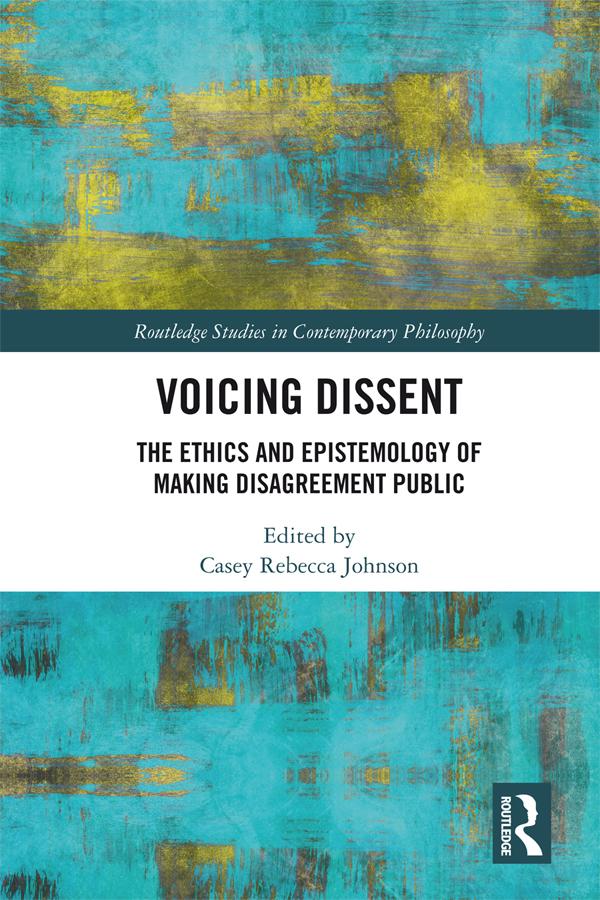
Disagreement is, for better or worse, pervasive in our society. Not only do we form beliefs that differ from those around us, but increasingly we have platforms and opportunities to voice those disagreements and make them public. In light of the public nature of many of our most important disagreements, a key question emerges: How does public disagreement affect what we know?
This volume collects original essays from a number of prominent scholars—including Catherine Elgin, Sanford Goldberg, Jennifer Lackey, Michael Patrick Lynch, and Duncan Pritchard, among others—to address this question in its diverse forms. The book is organized by thematic sections, in which individual chapters address the epistemic, ethical, and political dimensions of dissent. The individual contributions address important issues such as the value of disagreement, the nature of conversational disagreement, when dissent is epistemically rational, when one is obligated to voice disagreement or to object, the relation of silence and resistance to dissent, and when political dissent is justified. Voicing Dissent offers a new approach to the study of disagreement that will appeal to social epistemologists and ethicists interested in this growing area of epistemology.
Pay easily by card, Klarna, Apple Pay or Google Pay. Not happy? You always have a 14-day money-back guarantee. Read more in our terms. If you have any questions, email us at hello@memmo.org.
Memmo makes studying easier – wherever you are in the world. We bring your course books and smart study tools together in one place: summaries, quizzes, podcasts and flashcards. Plus Ted, your study buddy who answers anything you wonder. Over 50,000 students already study here – built to help you learn faster and stress less.