
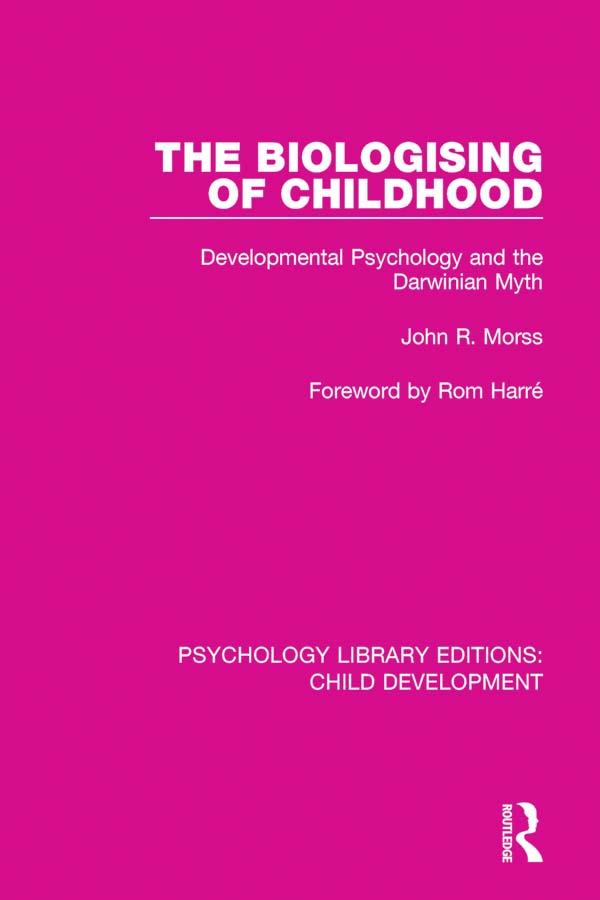
Originally published in 1990, this book looks at the history of developmental psychology in order to locate and evaluate the role played by biology in its most influential formulations.
First Charles Darwin’s own writings on child development are examined. It is shown that Darwin endorsed such ideas as the ‘recapitulation’ of evolutionary ancestry in the developing child, even though this is inconsistent with his natural selection theory. The first great developmentalists – Hall, Baldwin, Freud – adopted and applied these non-Darwinian evolutionist ideas. The next generation – Vygotsky, Piaget, Werner – applied similar ideas in a variety of ways.
Alongside this evolutionism, but interconnected with it, sensationist/empiricist forms of epistemology were directing developmentalists (from Rousseau onwards) to see the child as having to work himself out of sense-bound experience – to develop further and further from the ‘here-and-now’.
Contemporary developmental theory retains these influences: biological approaches (ethological, psychobiological) remain pre-Darwinian in spirit; lifespan theories remain attached to biology; formal/cognitive approaches remain attached to sensationism. ‘Social context’ approaches are rather half-hearted, and it is only the social-constructionist orientation which seems to offer a real alternative to biology. Major conclusions are stated in chapter ten, which includes a re-evaluation of Darwin’s role.
Pay easily by card, Klarna, Apple Pay or Google Pay. Not happy? You always have a 14-day money-back guarantee. Read more in our terms. If you have any questions, email us at hello@memmo.org.
Memmo makes studying easier – wherever you are in the world. We bring your course books and smart study tools together in one place: summaries, quizzes, podcasts and flashcards. Plus Ted, your study buddy who answers anything you wonder. Over 50,000 students already study here – built to help you learn faster and stress less.