
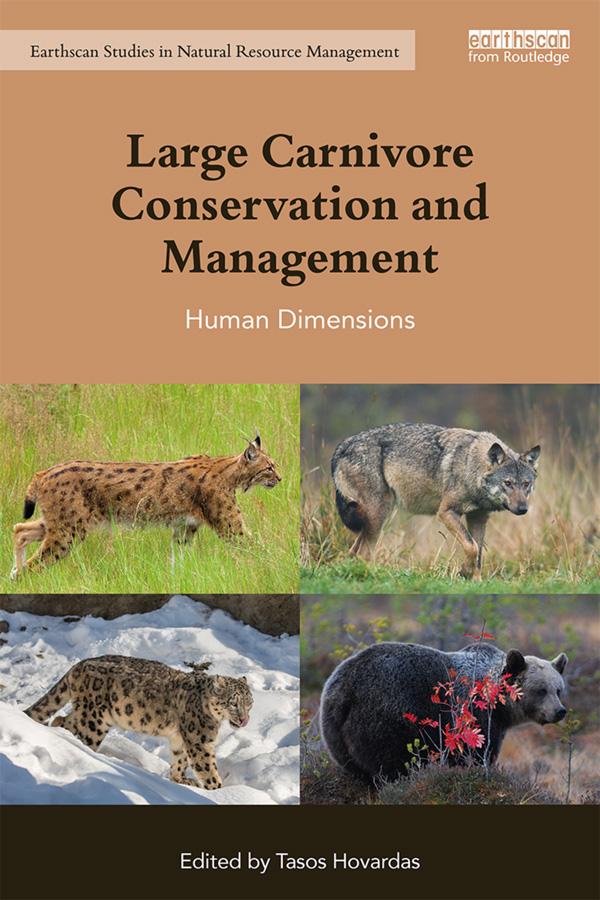
Large carnivores include iconic species such as bears, wolves and big cats. Their habitats are increasingly being shared with humans, and there is a growing number of examples of human-carnivore coexistence as well as conflict. Next to population dynamics of large carnivores, there are considerable attitude shifts towards these species worldwide with multiple implications.
This book argues and demonstrates why human dimensions of relationships to large carnivores are crucial for their successful conservation and management. It provides an overview of theoretical and methodological perspectives, heterogeneity in stakeholder perceptions and behaviour as well as developments in decision making, stakeholder involvement, policy and governance informed by human dimensions of large carnivore conservation and management. The scope is international, with detailed examples and case studies from Europe, North and South America, Central and South Asia, as well as debates of the challenges faced by urbanization, agricultural expansion, national parks and protected areas. The main species covered include bears, wolves, lynx, and leopards.
The book provides a novel perspective for advanced students, researchers and professionals in ecology and conservation, wildlife management, human-wildlife interactions, environmental education and environmental social science.
Pay easily by card, Klarna, Apple Pay or Google Pay. Not happy? You always have a 14-day money-back guarantee. Read more in our terms. If you have any questions, email us at hello@memmo.org.
Memmo makes studying easier – wherever you are in the world. We bring your course books and smart study tools together in one place: summaries, quizzes, podcasts and flashcards. Plus Ted, your study buddy who answers anything you wonder. Over 50,000 students already study here – built to help you learn faster and stress less.