
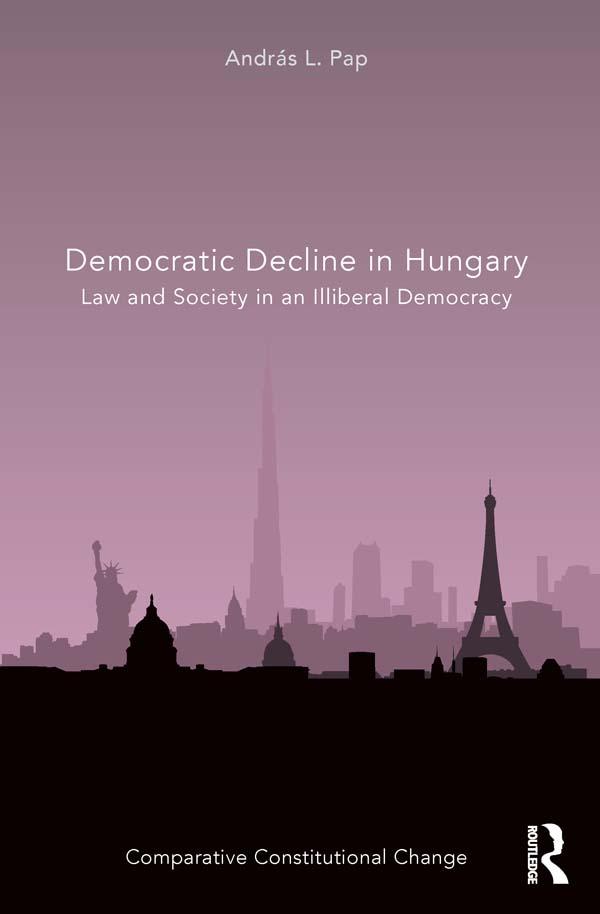
This book shows the rise and morphology of a self-identified `illiberal democracy’, the first 21st century illiberal political regime arising in the European Union. Since 2010, Viktor Orbán’s governments in Hungary have convincingly offered an anti-modernist and anti-cosmopolitan/anti-European Unionist rhetoric, discourse and constitutional identity to challenge neo-liberal democracy. The Hungarian case provides unique observation points for students of transitology, especially those who are interested in states which are to abandon pathways of liberal democracy.
The author demonstrates how illiberalism is present both in `how’ and `what’ is being done: the style, format and procedure of legislation; as well as the substance: the dismantling of institutional rule of law guarantees and the weakening of checks and balances. The book also discusses the ideological commitments and constitutionally framed and cemented value preferences, and a reconstituted and re-conceptualized relationship between the state and its citizens, which is not evidently supported by Hungarians’ value system and life-style choices.
Pay easily by card, Klarna, Apple Pay or Google Pay. Not happy? You always have a 14-day money-back guarantee. Read more in our terms. If you have any questions, email us at hello@memmo.org.
Memmo makes studying easier – wherever you are in the world. We bring your course books and smart study tools together in one place: summaries, quizzes, podcasts and flashcards. Plus Ted, your study buddy who answers anything you wonder. Over 50,000 students already study here – built to help you learn faster and stress less.