
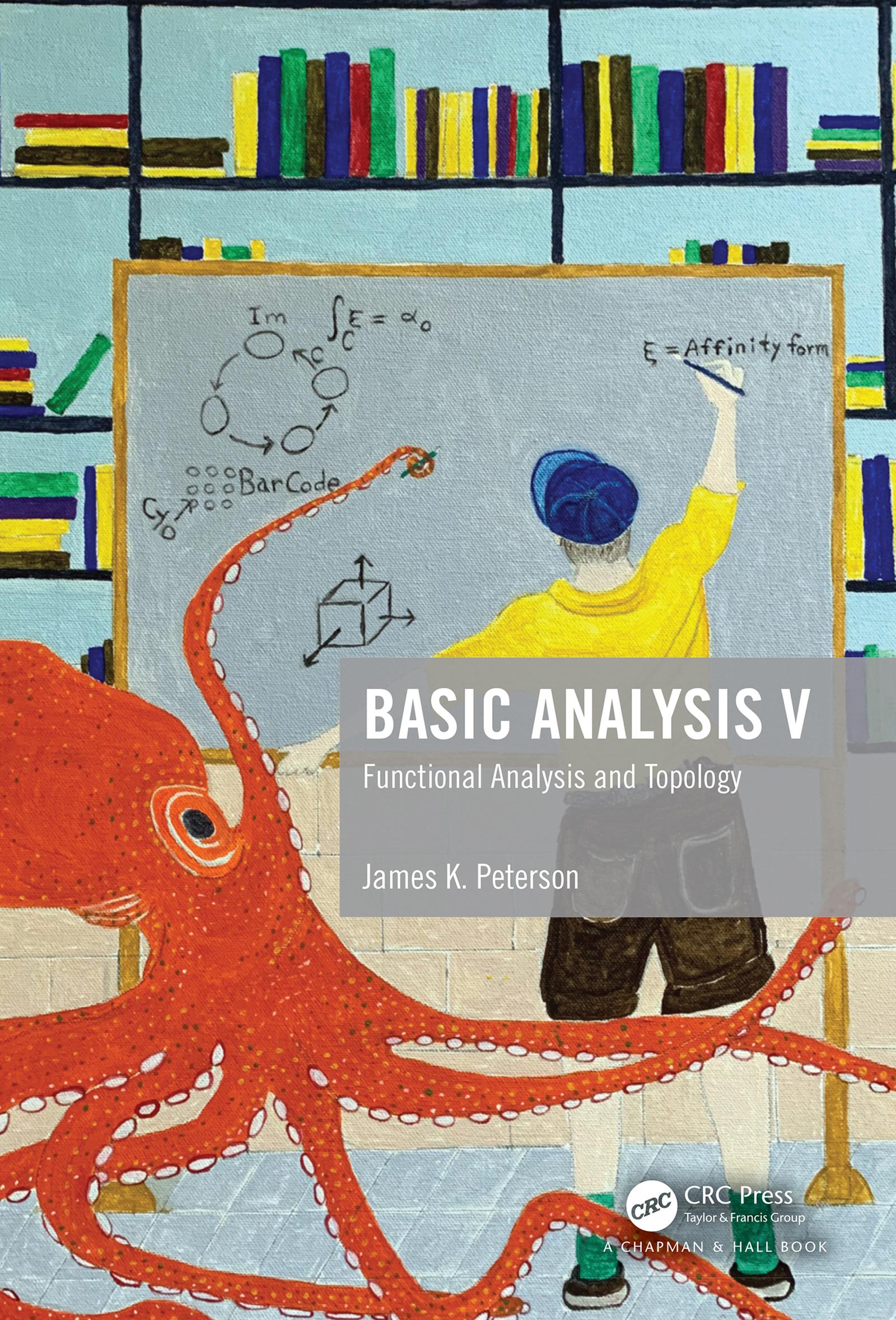
Basic Analysis V: Functional Analysis and Topology introduces graduate students in science to concepts from topology and functional analysis, both linear and nonlinear. It is the fifth book in a series designed to train interested readers how to think properly using mathematical abstractions, and how to use the tools of mathematical analysis in applications.
It is important to realize that the most difficult part of applying mathematical reasoning to a new problem domain is choosing the underlying mathematical framework to use on the problem. Once that choice is made, we have many tools we can use to solve the problem. However, a different choice would open up avenues of analysis from a different, perhaps more productive, perspective.
In this volume, the nature of these critical choices is discussed using applications involving the immune system and cognition.
Features
- Develops a proof of the Jordan Canonical form to show some basic ideas in algebraic topology
- Provides a thorough treatment of topological spaces, finishing with the Krein–Milman theorem
- Discusses topological degree theory (Brouwer, Leray–Schauder, and Coincidence)
- Carefully develops manifolds and functions on manifolds ending with Riemannian metrics
- Suitable for advanced students in mathematics and associated disciplines
- Can be used as a traditional textbook as well as for self-study
Author
James K. Peterson is an Emeritus Professor at the School of Mathematical and Statistical Sciences, Clemson University.
He tries hard to build interesting models of complex phenomena using a blend of mathematics, computation, and science. To this end, he has written four books on how to teach such things to biologists and cognitive scientists. These books grew out of his Calculus for Biologists courses offered to the biology majors from 2007 to 2015.
He has taught the analysis courses since he started teaching both at Clemson and at his previous post at Michigan Technological University.
In between, he spent time as a senior engineer in various aerospace firms and even did a short stint in a software development company. The problems he was exposed to were very hard, and not amenable to solution using just one approach. Using tools from many branches of mathematics, from many types of computational languages, and from first-principles analysis of natural phenomena was absolutely essential to make progress.
In both mathematical and applied areas, students often need to use advanced mathematics tools they have not learned properly. So, he has recently written a series of five books on mathematical analysis to help researchers with the problem of learning new things after they have earned their degrees and are practicing scientists. Along the way, he has also written papers in immunology, cognitive science, and neural network technology, in addition to having grants from the NSF, NASA, and the US Army.
He also likes to paint, build furniture, and write stories.
Pay easily by card, Klarna, Apple Pay or Google Pay. Not happy? You always have a 14-day money-back guarantee. Read more in our terms. If you have any questions, email us at hello@memmo.org.
Memmo makes studying easier – wherever you are in the world. We bring your course books and smart study tools together in one place: summaries, quizzes, podcasts and flashcards. Plus Ted, your study buddy who answers anything you wonder. Over 75,000 students already study here – built to help you learn faster and stress less.