
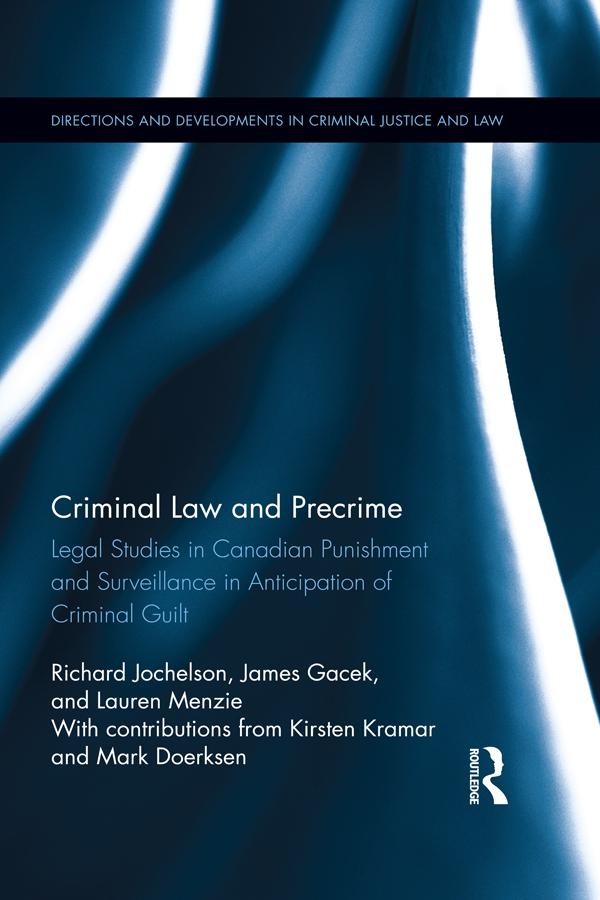
In Philip K. Dick’s short story Minority Report, the institution of Precrime punishes people with imprisonment for crimes they would have committed had they not been prevented. With Dick’s allegorical inspiration, the authors of Criminal Law and Precrime: Legal Studies in Canadian Punishment and Surveillance in Anticipation of Criminal Guilt posit that recent developments in Canadian law indicate a trend toward imposing punitive measures at increasingly earlier stages of the prosecutorial process. The result is a potentially new field of criminal management that could be characterized as "precrime"—particularly the use of the law as a technology of surveillance and prevention since "terror" became a justification for intervention.
The authors note that as risk management logics (based in actuarial sciences) have shifted to precautionary ones (based in administrative sciences), the law has responded by developing techniques in the arena of criminal regulation in light of the "war on terror": the need to ensure security, the proliferation of digital data, and the development of drones, social networking, and cloud storage to gather personal data. The authors view shifts in criminal investigation; the substantive criminal law of sexual expression, conduct, and work; and civil forfeiture as emblematic of precrime populism. The unifying theme of these techniques is that they occur prior to state-identified crime, arise out of a precautionary philosophy, and seek to presume (or circumvent) criminality.
The book is a provocative read for scholars and students in criminal law, policing, and surveillance, as well as for those interested in how areas of law, such as immigration, health, and anti-terrorism, are mobilizing the logics of risk and surveillance in new ways that emphasize precaution. The authors invite legal scholars to place the analytical lens of precrime on criminal and regulatory practices in Canada as well as other Western nations across the globe.
Pay easily by card, Klarna, Apple Pay or Google Pay. Not happy? You always have a 14-day money-back guarantee. Read more in our terms. If you have any questions, email us at hello@memmo.org.
Memmo makes studying easier – wherever you are in the world. We bring your course books and smart study tools together in one place: summaries, quizzes, podcasts and flashcards. Plus Ted, your study buddy who answers anything you wonder. Over 50,000 students already study here – built to help you learn faster and stress less.