
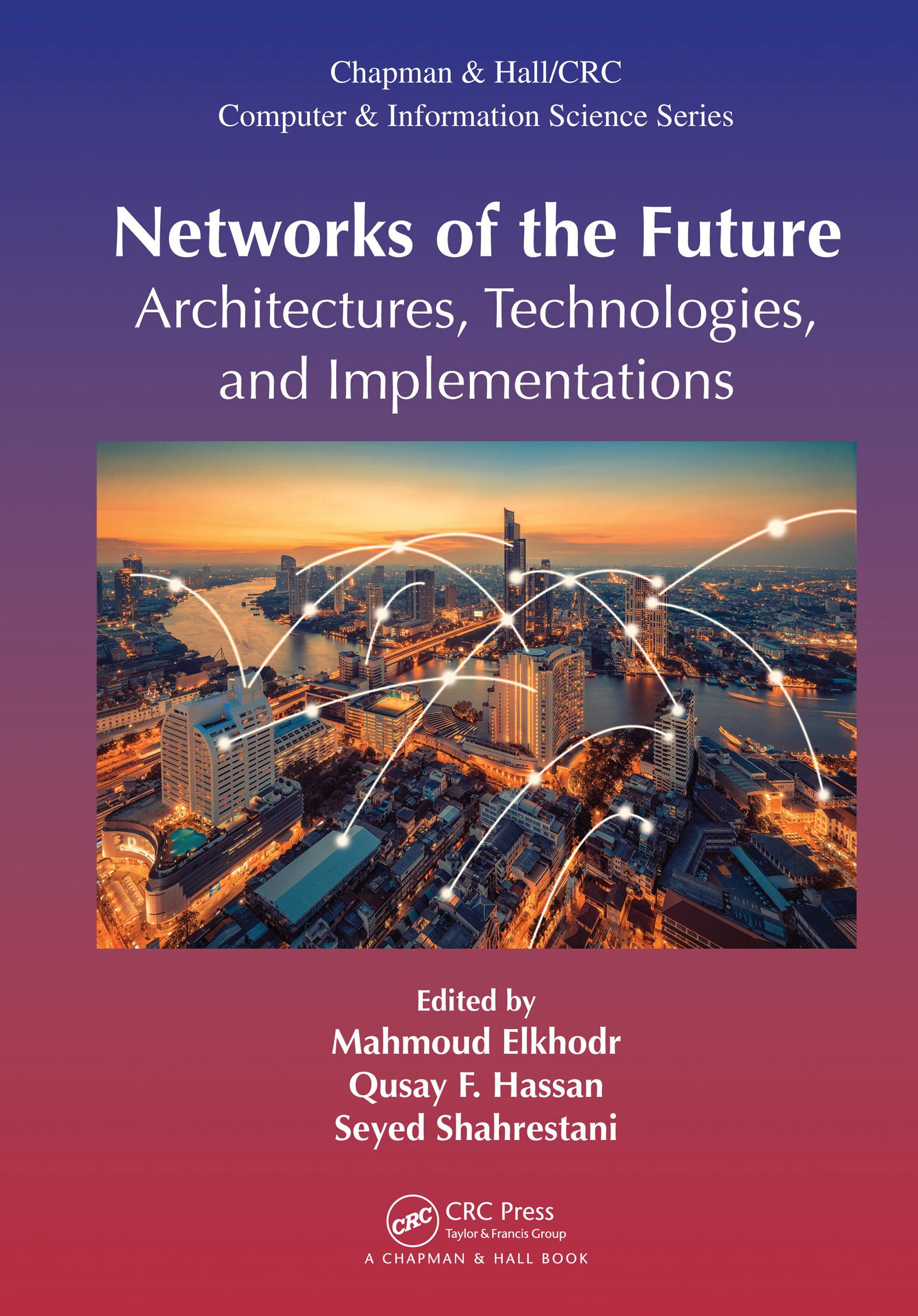
With the ubiquitous diffusion of the IoT, Cloud Computing, 5G and other evolved wireless technologies into our daily lives, the world will see the Internet of the future expand ever more quickly. Driving the progress of communications and connectivity are mobile and wireless technologies, including traditional WLANs technologies and low, ultra-power, short and long-range technologies. These technologies facilitate the communication among the growing number of connected devices, leading to the generation of huge volumes of data. Processing and analysis of such "big data" brings about many opportunities, as well as many challenges, such as those relating to efficient power consumptions, security, privacy, management, and quality of service. This book is about the technologies, opportunities and challenges that can drive and shape the networks of the future.
Written by established international researchers and experts, Networks of the Future answers fundamental and pressing research challenges in the field, including architectural shifts, concepts, mitigation solutions and techniques, and key technologies in the areas of networking. The book starts with a discussion on Cognitive Radio (CR) technologies as promising solutions for improving spectrum utilization, and also highlights the advances in CR spectrum sensing techniques and resource management methods.
The second part of the book presents the latest developments and research in the areas of 5G technologies and Software Defined Networks (SDN). Solutions to the most pressing challenges facing the adoption of 5G technologies are also covered, and the new paradigm known as Fog Computing is examined in the context of 5G networks.
The focus next shifts to efficient solutions for future heterogeneous networks. It consists of a collection of chapters that discuss self-healing solutions, dealing with Network Virtualization, QoS in heterogeneous networks, and energy efficient techniques for Passive Optical Networks and Wireless Sensor Networks. Finally, the areas of IoT and Big Data are discussed, including the latest developments and future perspectives of Big Data and the IoT paradigms.
Pay easily by card, Klarna, Apple Pay or Google Pay. Not happy? You always have a 14-day money-back guarantee. Read more in our terms. If you have any questions, email us at hello@memmo.org.
Memmo makes studying easier – wherever you are in the world. We bring your course books and smart study tools together in one place: summaries, quizzes, podcasts and flashcards. Plus Ted, your study buddy who answers anything you wonder. Over 75,000 students already study here – built to help you learn faster and stress less.