
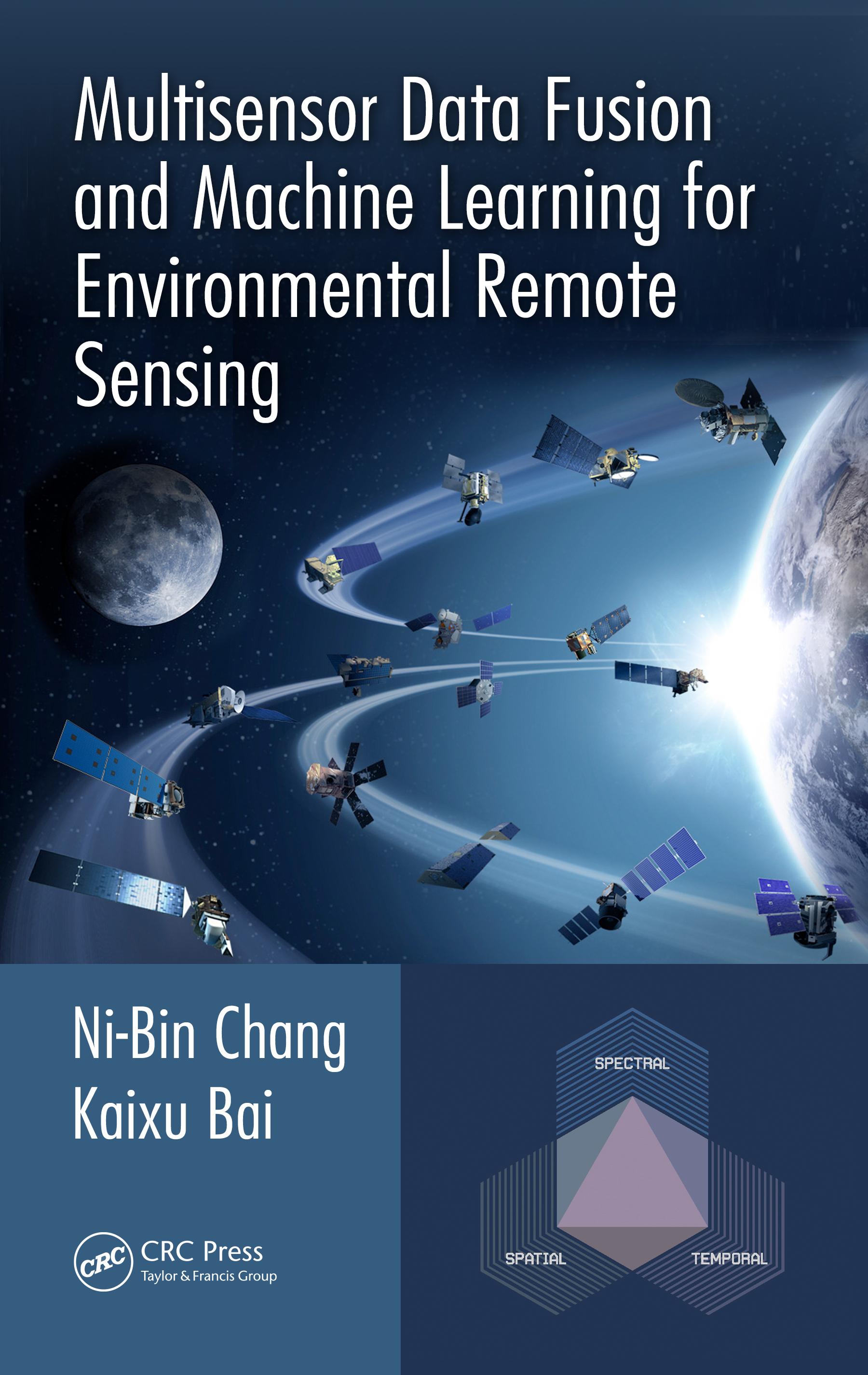
In the last few years the scientific community has realized that obtaining a better understanding of interactions between natural systems and the man-made environment across different scales demands more research efforts in remote sensing. An integrated Earth system observatory that merges surface-based, air-borne, space-borne, and even underground sensors with comprehensive and predictive capabilities indicates promise for revolutionizing the study of global water, energy, and carbon cycles as well as land use and land cover changes.
The aim of this book is to present a suite of relevant concepts, tools, and methods of integrated multisensor data fusion and machine learning technologies to promote environmental sustainability. The process of machine learning for intelligent feature extraction consists of regular, deep, and fast learning algorithms. The niche for integrating data fusion and machine learning for remote sensing rests upon the creation of a new scientific architecture in remote sensing science that is designed to support numerical as well as symbolic feature extraction managed by several cognitively oriented machine learning tasks at finer scales. By grouping a suite of satellites with similar nature in platform design, data merging may come to help for cloudy pixel reconstruction over the space domain or concatenation of time series images over the time domain, or even both simultaneously.
Organized in 5 parts, from Fundamental Principles of Remote Sensing; Feature Extraction for Remote Sensing; Image and Data Fusion for Remote Sensing; Integrated Data Merging, Data Reconstruction, Data Fusion, and Machine Learning; to Remote Sensing for Environmental Decision Analysis, the book will be a useful reference for graduate students, academic scholars, and working professionals who are involved in the study of Earth systems and the environment for a sustainable future. The new knowledge in this book can be applied successfully in many areas of environmental science and engineering.
Pay easily by card, Klarna, Apple Pay or Google Pay. Not happy? You always have a 14-day money-back guarantee. Read more in our terms. If you have any questions, email us at hello@memmo.org.
Memmo makes studying easier – wherever you are in the world. We bring your course books and smart study tools together in one place: summaries, quizzes, podcasts and flashcards. Plus Ted, your study buddy who answers anything you wonder. Over 50,000 students already study here – built to help you learn faster and stress less.