
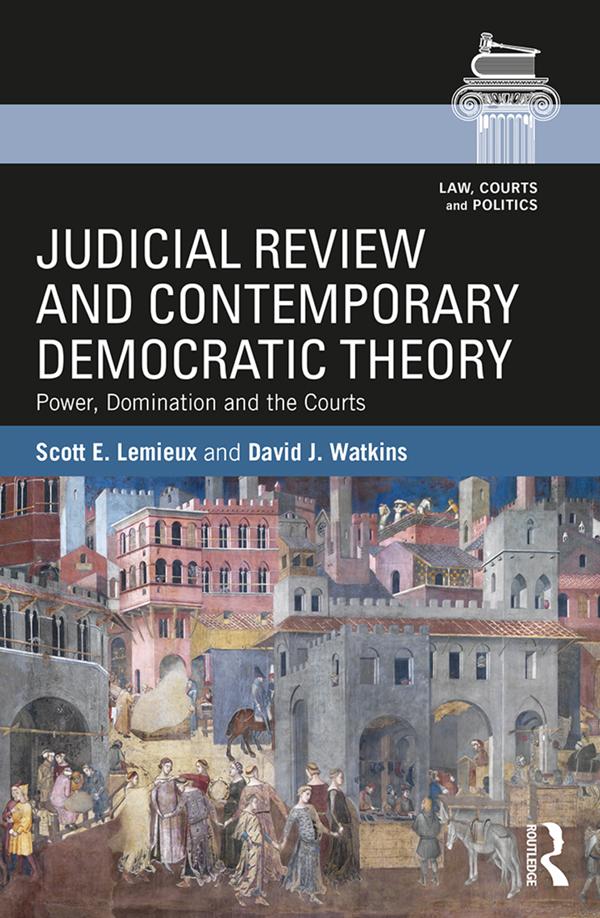
For decades, the question of judicial review’s status in a democratic political system has been adjudicated through the framework of what Alexander Bickel labeled "the counter-majoritarian difficulty." That is, the idea that judicial review is particularly problematic for democracy because it opposes the will of the majority.
Judicial Review and Contemporary Democratic Theory begins with an assessment of the empirical and theoretical flaws of this framework, and an account of the ways in which this framework has hindered meaningful investigation into judicial review’s value within a democratic political system. To replace the counter-majoritarian difficulty framework, Scott E. Lemieux and David J. Watkins draw on recent work in democratic theory emphasizing democracy’s opposition to domination and analyses of constitutional court cases in the United States, Canada, and elsewhere to examine judicial review in its institutional and political context.
Developing democratic criteria for veto points in a democratic system and comparing them to each other against these criteria, Lemieux and Watkins yield fresh insights into judicial review’s democratic value. This book is essential reading for students of law and courts, judicial politics, legal theory and constitutional law.
Pay easily by card, Klarna, Apple Pay or Google Pay. Not happy? You always have a 14-day money-back guarantee. Read more in our terms. If you have any questions, email us at hello@memmo.org.
Memmo makes studying easier – wherever you are in the world. We bring your course books and smart study tools together in one place: summaries, quizzes, podcasts and flashcards. Plus Ted, your study buddy who answers anything you wonder. Over 50,000 students already study here – built to help you learn faster and stress less.