
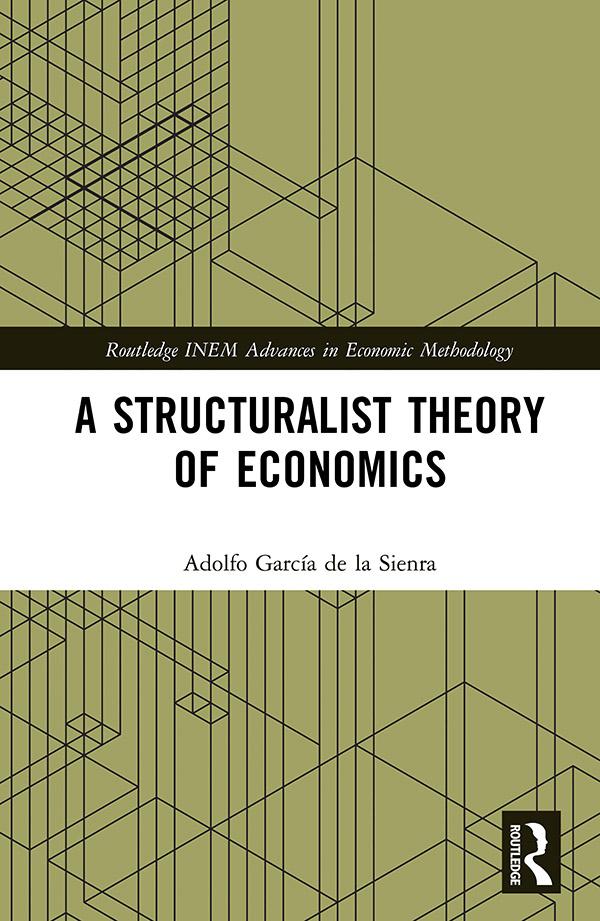
Economists have long grappled with the problem of how economic theories relate to empirical evidence: how can abstract mathematized theories be used to produce empirical claims? How are such theories applied to economic phenomena? What does it mean to “test” economic theories? This book introduces, explains, and develops a structural philosophy of economics which addresses these questions and provides a unifying philosophical/logical basis for a general methodology of economics.
The book begins by introducing a rigorous view of the logical foundations and structure of scientific theories based upon the work of Alfred Tarski, Patrick Suppes, Karl Marx, and others. Using and combining their methods, the book then goes on to reconstruct important economic theories – including utility theory, game theory, Marxian economics, Sraffian economic theory, and econometrics – proving all the main theorems and discussing the key claims and the empirical applicability of each theory. Through these discussions, this book presents, in a systematic fashion, a general philosophy of economics grounded in the structural view.
Offering rigorous formulations of important economic theories, A Structuralist Theory of Economics will be invaluable to all readers interested in the logic, philosophy, and methodology of economics. It will also appeal particularly to those interested in economic theory.
Pay easily by card, Klarna, Apple Pay or Google Pay. Not happy? You always have a 14-day money-back guarantee. Read more in our terms. If you have any questions, email us at hello@memmo.org.
Memmo makes studying easier – wherever you are in the world. We bring your course books and smart study tools together in one place: summaries, quizzes, podcasts and flashcards. Plus Ted, your study buddy who answers anything you wonder. Over 50,000 students already study here – built to help you learn faster and stress less.