
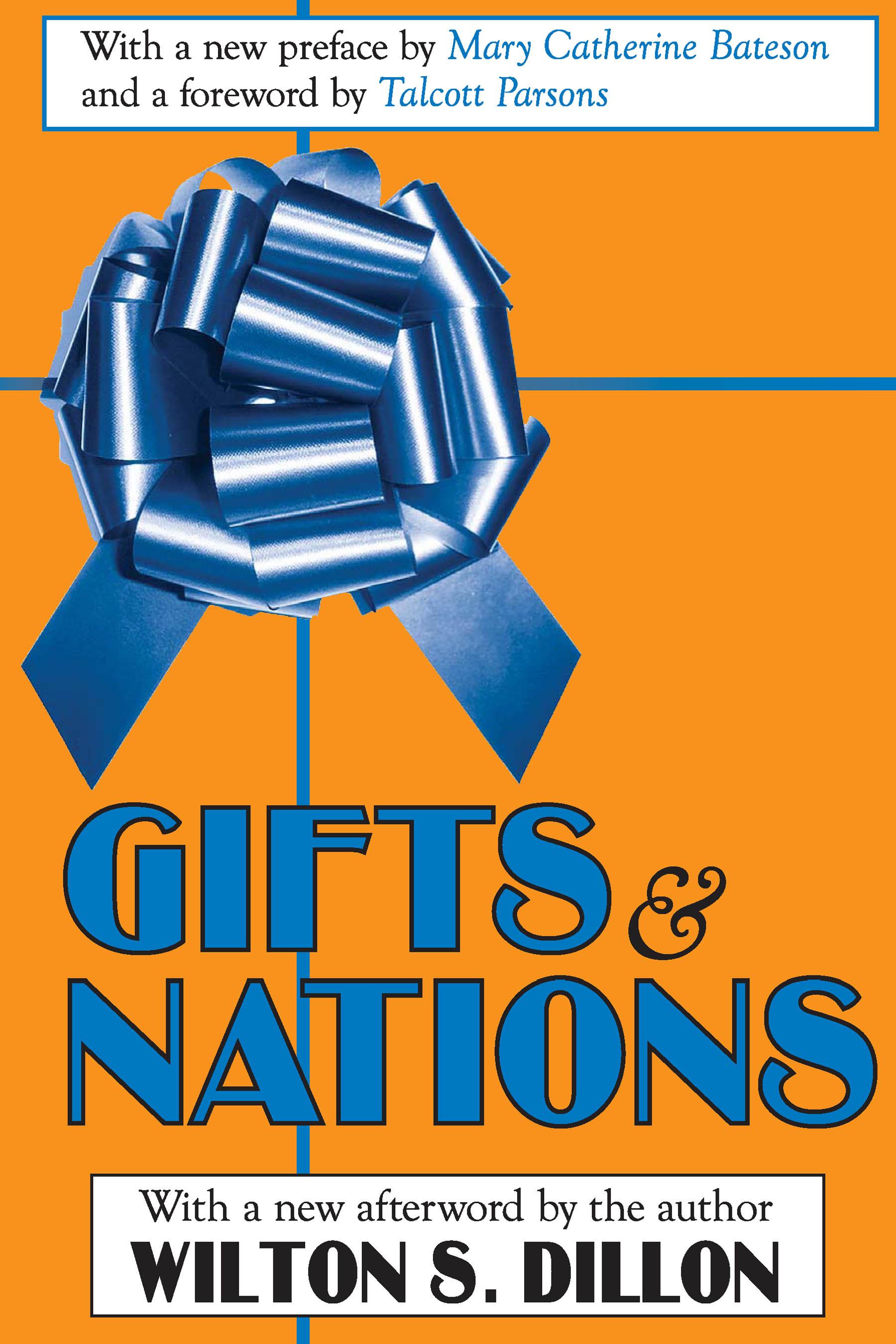
What can men in industrial nations learn from their "primitive" contemporaries, and the habits of earlier civilizations? This book by acclaimed cultural anthropologist Wilton S. Dillon suggests that modern political, religious, and scientific communities--and alliances--would be enhanced greatly if we understood how gift exchange and reciprocity helped to balance earlier institutions and societies.Using the example of the gift behavior of France and the United States during the Marshall Plan period, Gifts and Nations examines the troubles that arise between donors and recipients when a generous donor remains innocent of the recipient's desire to give back things or ideas to which both attach value. Such innocence may produce what the author calls "the Gaullist effect"--a quest for self-esteem, autonomy, and initiative by a person, or a nation, who feels burdened and controlled by undischarged obligations.Gifts and Nations is very much an historical footnote to the rise of PaxAmericana--the American empire having been launched in 1898, enlarged in the aftermath of World War II and the Cold War, and now the subject of global debate. This volume emphasizes that building coalitions and keeping alliances strong require multi-lateralism based on reciprocity.
Pay easily by card, Klarna, Apple Pay or Google Pay. Not happy? You always have a 14-day money-back guarantee. Read more in our terms. If you have any questions, email us at hello@memmo.org.
Memmo makes studying easier – wherever you are in the world. We bring your course books and smart study tools together in one place: summaries, quizzes, podcasts and flashcards. Plus Ted, your study buddy who answers anything you wonder. Over 50,000 students already study here – built to help you learn faster and stress less.
You might also like
Buy the book0