
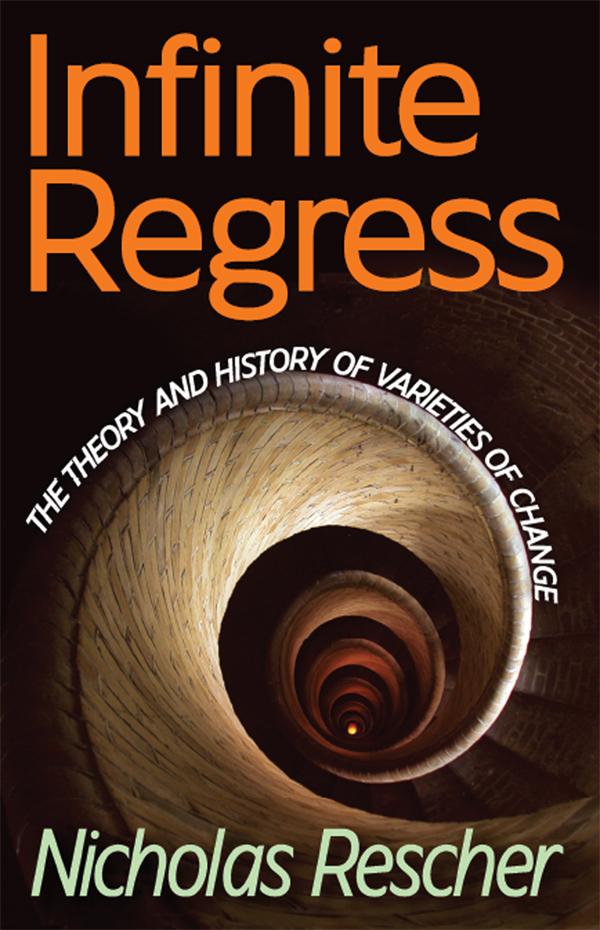
Regression addresses what has come before; it is a matter of looking backward of retrospections? The motionless things of nature are generally forward-looking their problem is that of the question: Where do we go from here? It is primarily with intelligent beings that we ask: How did we get to where we now find ourselves? Regression and infinite regression in particular is thus a concept that has gained a greater prominence in the human sciences than in the sciences of nature. Argumentation to infinite regress has long been a favored instrument of philosophical dialectic. Philosophers have used it to disprove the positions they model to criticize. Infinite regresses, so they reason, are unrealizable: they cannot be completed so as to achieve some definitive result. And thereby anything that would engender an infinite regress is automatically made ineffective. Infinite Regress examines the theory of regression and includes information on the topics of vicious regress, innocuous regress, circularity regress, and propositional regress. Also discussed is the history of regression stemming from ancient times, to medieval times, to early modern history. Some of the other chapters in this book focus on world class philosophers including Immanuel Kant, Georg Wilhelm Friedrich Hegel, and Bertrand Russell. The book will play a significant role in theoretical philosophy as well as in social philosophy and the philosophy of mind.
Pay easily by card, Klarna, Apple Pay or Google Pay. Not happy? You always have a 14-day money-back guarantee. Read more in our terms. If you have any questions, email us at hello@memmo.org.
Memmo makes studying easier – wherever you are in the world. We bring your course books and smart study tools together in one place: summaries, quizzes, podcasts and flashcards. Plus Ted, your study buddy who answers anything you wonder. Over 50,000 students already study here – built to help you learn faster and stress less.
You might also like
Buy the book0