
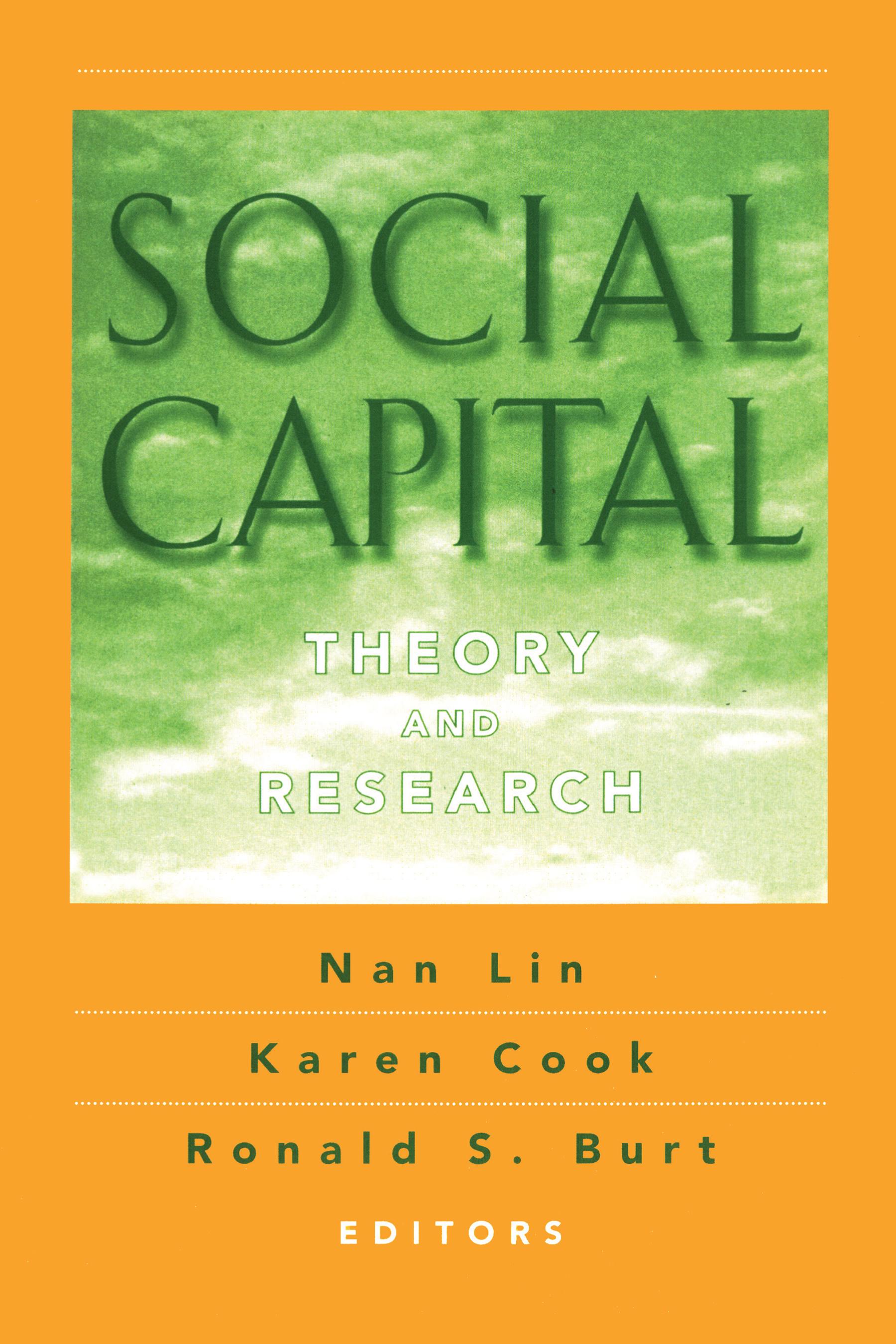
Leading scholars in the field of social networks from diverse disciplines present the first systematic and comprehensive collection of current theories and empirical research on the informal connections that individuals have for support, help, and information from other people. Expanding on concepts originally formulated by Pierre Bourdieu and James Coleman, this seminal work will find an essential place with educators and students in the fields of social networks, rational choice theory, institutions, and the socioeconomics of poverty, labor markets, social psychology, and race.
The volume is divided into three parts. The first segment clarifies social capital as a concept and explores its theoretical and operational bases. Additional segments provide brief accounts that place the development of social capital in the context of the family of capital theorists, and identify some critical but controversial perspectives and statements regarding social capital in the literature. The editors then make the argument for the network perspective, why and how such a perspective can clarify controversies and advance our understanding of a whole range of instrumental and expressive outcomes.
Social Capital further provides a forum for ongoing research programs initiated by social scientists working at the crossroads of formal theory and new methods. These scholars and programs share certain understandings and approaches in their analyses of social capital. They argue that social networks are the foundation of social capital. Social networks simultaneously capture individuals and social structure, thus serving as a vital conceptual link between actions and structural constraints, between micro- and macro-level analyses, and between relational and collective dynamic processes. They are further cognizant of the dual significance of the "structural" features of the social networks and the "resources" embedded in the networks as defining elements of social c
Pay easily by card, Klarna, Apple Pay or Google Pay. Not happy? You always have a 14-day money-back guarantee. Read more in our terms. If you have any questions, email us at hello@memmo.org.
Memmo makes studying easier – wherever you are in the world. We bring your course books and smart study tools together in one place: summaries, quizzes, podcasts and flashcards. Plus Ted, your study buddy who answers anything you wonder. Over 50,000 students already study here – built to help you learn faster and stress less.