
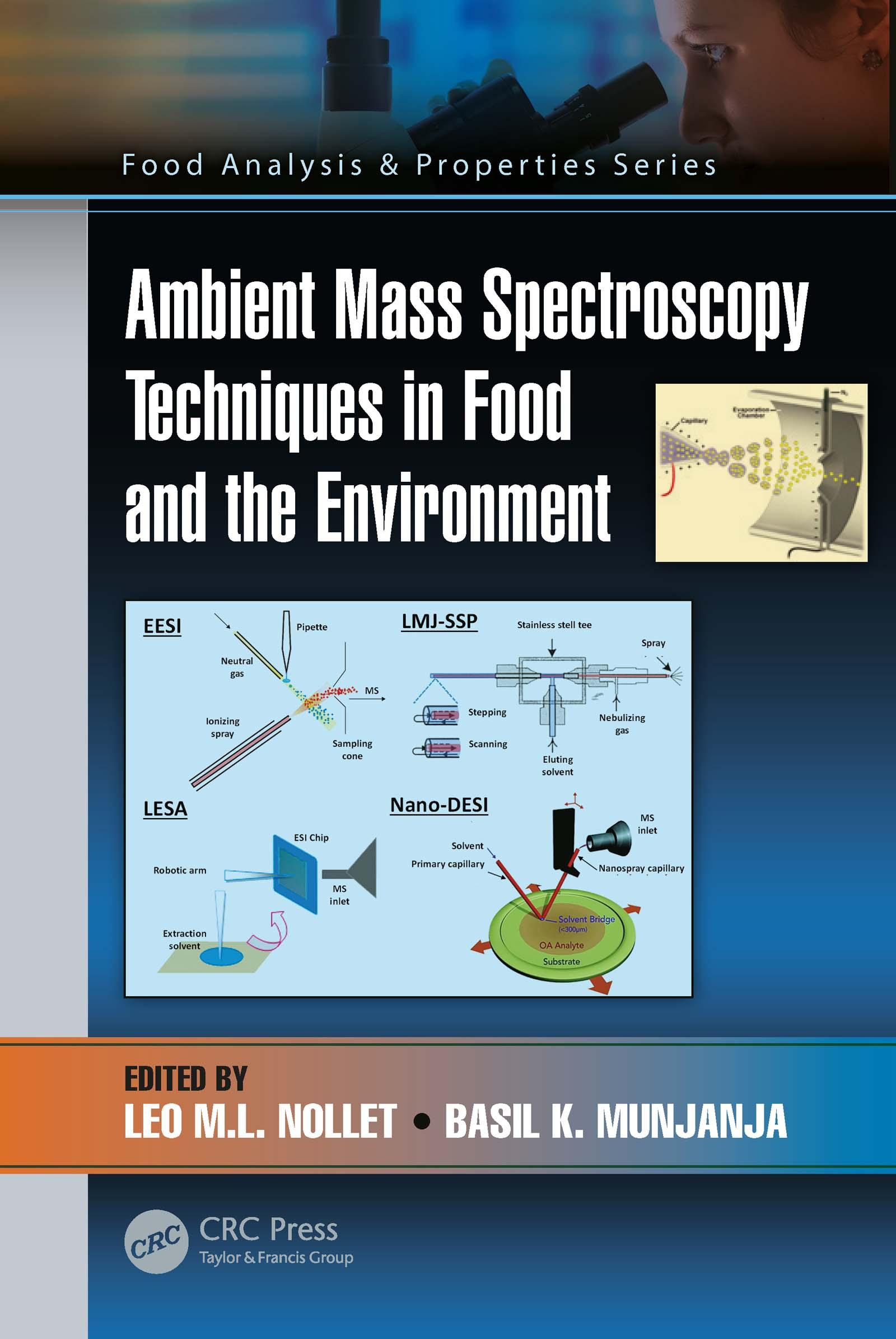
Ambient mass spectrometry—that is the use of mass spec but in the atmospheric environment—has been widely employed in food and environmental analysis. Ambient Mass Spectroscopy Techniques in Food and the Environment presents the theoretical underpinnings of mass spectrometry, and the benefits and pitfalls of ambient mass spectrometry, as well as the latest developments of the technique, in the analysis of food and environmental parameters. It describes methods that enable the detection of surface materials like waxes, alkaloids, flavors, or pesticides by plainly exposing the corresponding items to the ionization region of the interface, without harm to samples.
Features:
- Explains the theoretical aspects of ambient mass spectrometry
- Describes how to use ambient MS techniques for food safety, authenticity, and traceability screening
- Lists the benefits of ambient MS in analysis of food and environmental parameters
- Covers recent developments of ambient MS in analysis of food and environmental parameters
The specialized work provides insight to professionals practicing in food and the environment, including food scientists, food engineers, food biotechnologists, chemical engineers, and those working in research labs, universities, and government regulatory agencies.
Pay easily by card, Klarna, Apple Pay or Google Pay. Not happy? You always have a 14-day money-back guarantee. Read more in our terms. If you have any questions, email us at hello@memmo.org.
Memmo makes studying easier – wherever you are in the world. We bring your course books and smart study tools together in one place: summaries, quizzes, podcasts and flashcards. Plus Ted, your study buddy who answers anything you wonder. Over 75,000 students already study here – built to help you learn faster and stress less.