
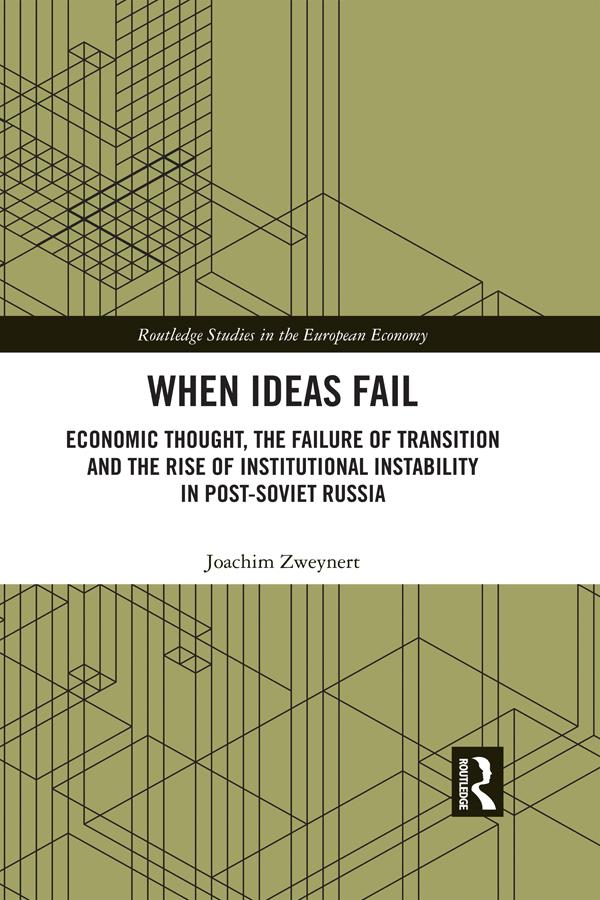
In the history of Russian economic ideas, a peculiar mix of anthropocentrism and holism provided fertile breeding ground for patterns of thought that were in potential conflict with the market. These patterns, did not render the emergence of capitalism in Russia impossible. But they entailed a deep intellectual division between adherents and opponents of Russia’s capitalist transformation that made Russia’s social evolution unstable and vulnerable to external shocks.
This study offers an ideational explanation of Russia’s relative failure to establish a functioning market economy and thus sets up a new and original perspective for discussion. In post-Soviet Russia, a clash between imported foreground ideas and deep domestic background ideas has led to an ideational division among the elite of the country. Within economic science, this led to the emergence of two thought collectives, (in the sense of Ludvik Fleck), with entirely different understandings of social reality.
This ideational division translated into incoherent policy measures, the emergence of institutional hybrids and thus, all in all, into institutional instability. Empirically, the book is based on a systematic, qualitative analysis of the writings of Soviet/Russian economists between 1987 and 2012.
This groundbreaking book makes an important contribution to Central Eastern and Eastern European area studies and to the current debate on ideas and institutions in the social sciences.
Pay easily by card, Klarna, Apple Pay or Google Pay. Not happy? You always have a 14-day money-back guarantee. Read more in our terms. If you have any questions, email us at hello@memmo.org.
Memmo makes studying easier – wherever you are in the world. We bring your course books and smart study tools together in one place: summaries, quizzes, podcasts and flashcards. Plus Ted, your study buddy who answers anything you wonder. Over 50,000 students already study here – built to help you learn faster and stress less.