
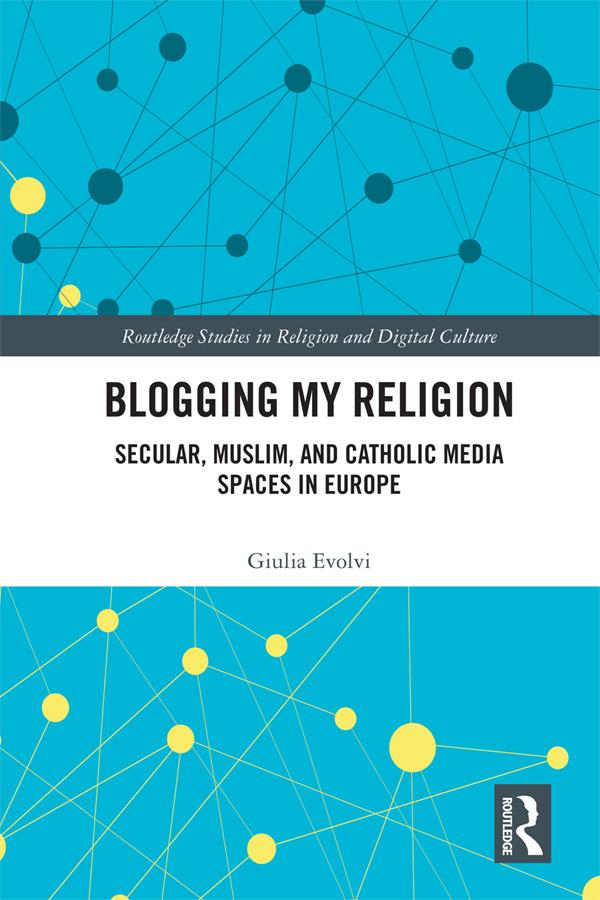
Religion in Europe is currently undergoing changes that are reconfiguring physical and virtual spaces of practice and belief, and these changes need to be understood with regards to the proliferation of digital media discourses. This book explores religious change in Europe through a comparative approach that analyzes Atheist, Catholic, and Muslim blogs as spaces for articulating narratives about religion that symbolically challenge the power of religious institutions.
The book adds theoretical complexity to the study of religion and digital media with the concept of hypermediated religious spaces. The theory of hypermediation helps to critically discuss the theory of secularization and to contextualize religious change as the result of multiple entangled phenomena. It considers religion as being connected with secular and post-secular spaces, and media as embedding material forms, institutions, and technologies. A spatial perspective contextualizes hypermediated religious spaces as existing at the interstice of alternative and mainstream, private and public, imaginary and real venues.
By offering the innovative perspective of hypermediated religious spaces, this book will be of significant interest to scholars of religious studies, the sociology of religion, and digital media.
Pay easily by card, Klarna, Apple Pay or Google Pay. Not happy? You always have a 14-day money-back guarantee. Read more in our terms. If you have any questions, email us at hello@memmo.org.
Memmo makes studying easier – wherever you are in the world. We bring your course books and smart study tools together in one place: summaries, quizzes, podcasts and flashcards. Plus Ted, your study buddy who answers anything you wonder. Over 50,000 students already study here – built to help you learn faster and stress less.