
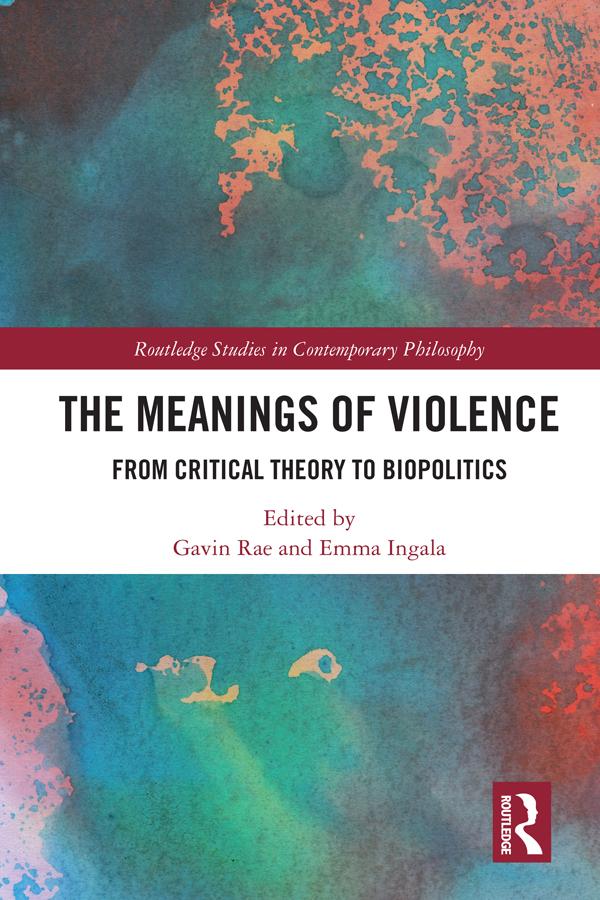
Violence has long been noted to be a fundamental aspect of the human condition. Traditionally, however, philosophical discussions have tended to approach it through the lens of warfare and/or limit it to physical forms. This changed in the twentieth century as the nature and meaning of ‘violence’ itself became a conceptual problem. Guided by the contention that Walter Benjamin’s famous 1921 ‘Critique of Violence’ essay inaugurated this turn to an explicit questioning of violence, this collection brings together an international array of scholars to engage with how subsequent thinkers—Agamben, Arendt, Benjamin, Butler, Castoriadis, Derrida, Fanon, Gramsci, Merleau-Ponty, Sartre, and Schmitt—grappled with the meaning and place of violence. The aim is not to reduce these multiple responses to a singular one, but to highlight the heterogeneous ways in which the concept has been inquired into and the manifold meanings of it that have resulted. To this end, each chapter focuses on a different approach or thinker within twentieth and twenty-first century European philosophy, with many of them tackling the issue through the mediation of other topics and disciplines, including biopolitics, epistemology, ethics, culture, law, politics, and psychoanalysis. As such, the volume will be an invaluable resource for those interested in Critical Theory, Cultural Studies, History of Ideas, Philosophy, Politics, Political Theory, Psychology, and Sociology.
Pay easily by card, Klarna, Apple Pay or Google Pay. Not happy? You always have a 14-day money-back guarantee. Read more in our terms. If you have any questions, email us at hello@memmo.org.
Memmo makes studying easier – wherever you are in the world. We bring your course books and smart study tools together in one place: summaries, quizzes, podcasts and flashcards. Plus Ted, your study buddy who answers anything you wonder. Over 50,000 students already study here – built to help you learn faster and stress less.