
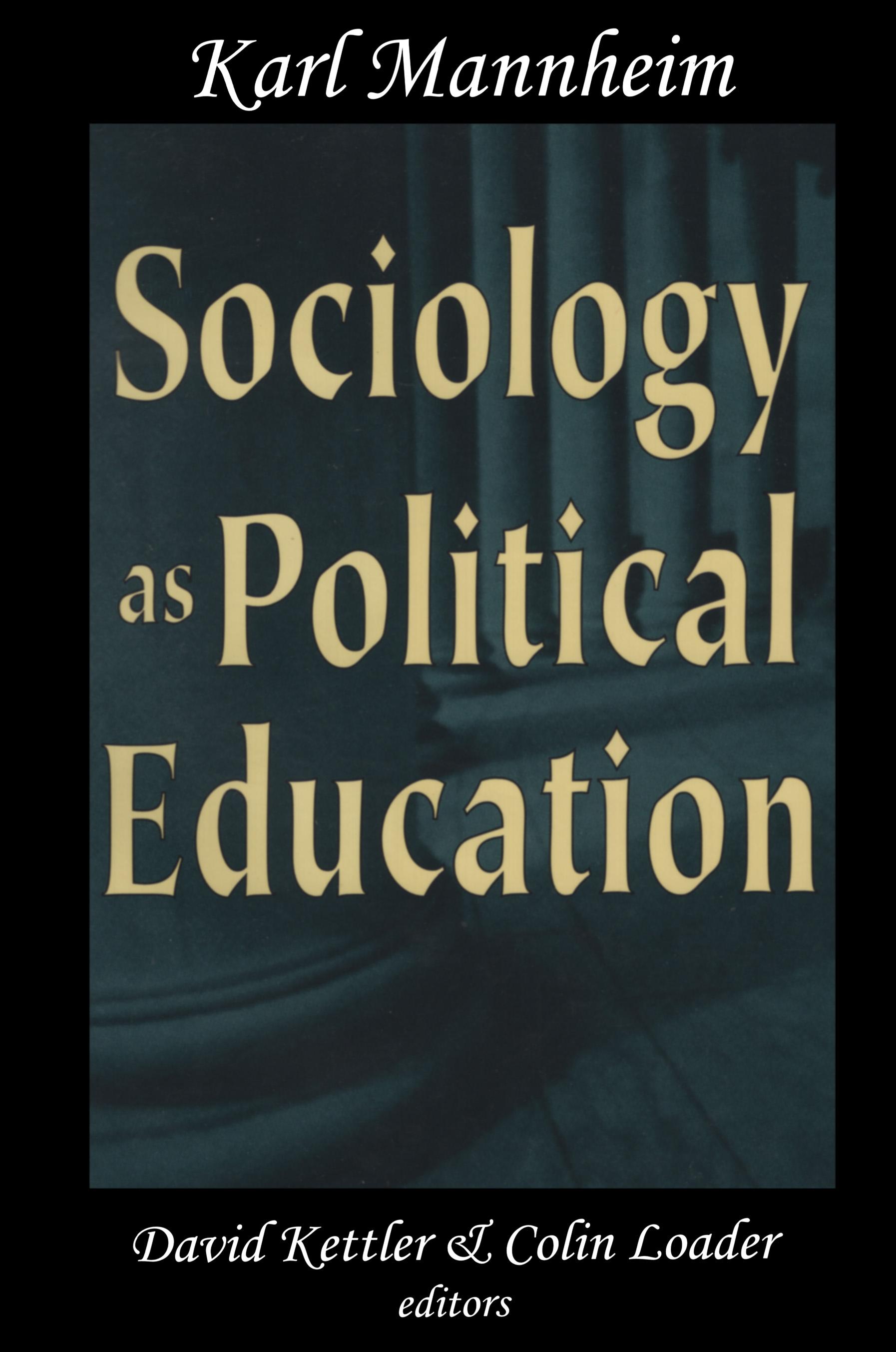
German professors and academic intellectuals are often blamed for passivity or complicity in the National Socialist rise to power. Karl Mannheim was a leading representative of a vital minority of university personalities who devoted themselves to making sociology and higher education contribute to democratization. Sociology as Political Education is both an analytical account of Mannheim's efforts as well as an illustration of the application of sociological knowledge to the world of practical action. Together with a second biographical volume by the editors, forthcoming next season, it comprisesa complete record of Karl Mannheim in the university life of the Weimar period.
The comparatively new discipline of sociology was looked upon with favor by the Weimar Republic's reformers of higher education. In advancing its methods Mannheim had first to contend first with prominent and influential figures who attacked sociology as a mere political device to undermine cultural and national values for the sake of narrow interests and partisanship. He then had to meet the objections of fellow sociologists who were convinced that the discipline could prosper only as an area of specialized study with no claim to educational goals beyond the technical reproduction. Finally, he had to separate himself from proponents of politicized sociology. Sociological thought should be rigorous, critical, and attentive to evidence, but, Mannheim argued, its system had to be open and congruent with the ultimate responsibility of human beings for their acts.
Loader and Kettler supplement Mannheim's groundbreaking volume with previously untranslated Mannheim texts, among them a transcript of his 1930 sociology course in which Mannheim answered his critics and clarified his intentions. Sociology as Political Education is not only of historical significance, but also shows Mannheim's relevance for current discussions of academic integrity and politicization. This volume will be of interest to sociologists, cultural historians, and political scientists.
Pay easily by card, Klarna, Apple Pay or Google Pay. Not happy? You always have a 14-day money-back guarantee. Read more in our terms. If you have any questions, email us at hello@memmo.org.
Memmo makes studying easier – wherever you are in the world. We bring your course books and smart study tools together in one place: summaries, quizzes, podcasts and flashcards. Plus Ted, your study buddy who answers anything you wonder. Over 50,000 students already study here – built to help you learn faster and stress less.