
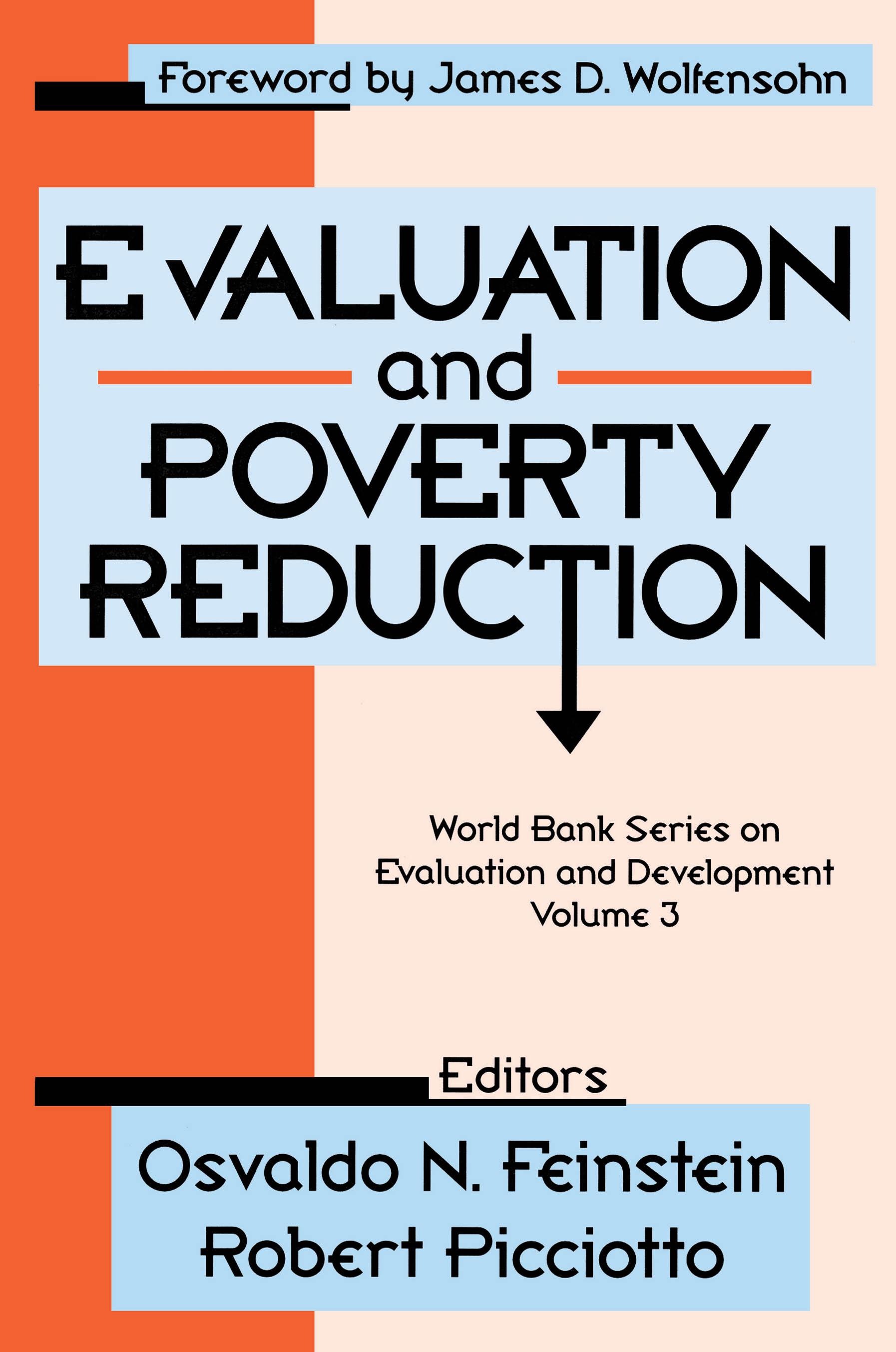
In his foreword, the president of the World Bank, James D. Wolfensohn, states plainly and precisely the rationale for this volume. "Evaluation is a central aspect of any poverty reduction endeavor. Evaluation implies that we have adopted a methodology that allows us to look in an effective way at the results of what we are doing so that we can, in turn, adapt our future actions toward the effective achievement of our goals. Evaluation adds value if we can learn something useful from it. It is not just a scorecard. It is something that helps us change our behavior or influence the behavior of others."This high powered collection of papers illustrates this statement. The network of world class scholars and development practitioners covers the gamut from methodological issues to policy concerns with respect to participatory evaluation, poverty reducing growth, macro and micro levels of intervention, health, nutrition and population programs, social inclusion and the changing role of the civil society. The participants include major figures, including a Nobel Laureate as well as cutting edge policy makers. Poverty reduction is examined in innovative ways-utilizing state of the art techniques of the social and economic sciences.The editors and contributors emphasize "what works" in poverty reduction programs. They point to making interventions context specific with a holistic vision of the problem. Contributors emphasize social funds and safety nets, social services, crisis prevention, informal social security and insurance systems, anti-corruption programs, mobilization of the poor, and ultimately, the creation, where none existed in the past, of a workable civil society. In short, this volume lies at the intersection of development economics and political economy. It seeks to promote development effectiveness through social learning and problem solving.The volume is unabashedly focussed on pro-poor growth. It has its roots in a conference sponsored by the Operations Evaluation Department, an independent unit within the World Bank. The goals of evaluation are to learn from experience, to provide an objective basis for assessing the results of the Bank's work, and to provide accountability in the achievement of its objectives.Osvaldo N. Feinstein is a manager, and Robert Picciotto, director general of the Operations Evaluation Department. The World Bank is located in Washington, D.C. with offices throughout the developing world.
Pay easily by card, Klarna, Apple Pay or Google Pay. Not happy? You always have a 14-day money-back guarantee. Read more in our terms. If you have any questions, email us at hello@memmo.org.
Memmo makes studying easier – wherever you are in the world. We bring your course books and smart study tools together in one place: summaries, quizzes, podcasts and flashcards. Plus Ted, your study buddy who answers anything you wonder. Over 50,000 students already study here – built to help you learn faster and stress less.