
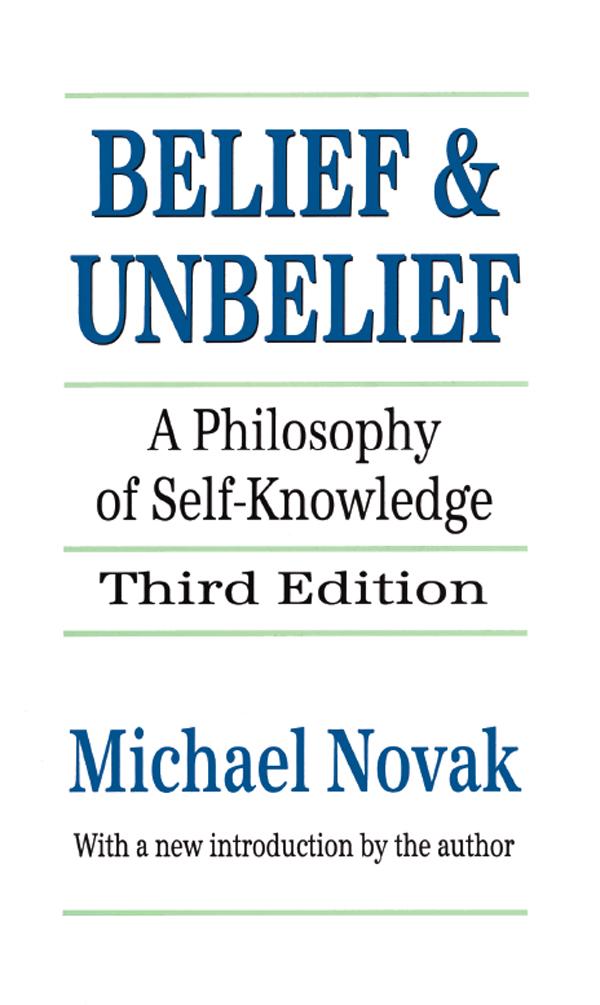
This is perhaps the most widely read of Michael Novak's books. Belief and Unbelief attempts to push intelligence and articulation as far as possible into the stuff of what so many philosophers set aside as subjectivity. It is an impassioned critique of the idea of an unbridgeable gap between the emotive and the cognitive � and in its own way, represents a major thrust at positivist analysis.
Written in a context of personal tragedy as well as intellectual search, the book is grounded in the belief that human experience is enclosed within a person to person relationship with the source of all things � sometimes in darkness, other tunes in aridity, but always in deep encounter with community and courage. It is written with a deep fidelity to classical Catholic thought as well as a sense of the writings of sociology, anthropology, and political theory�from Harold Lasswell to Friedrich von Hayek.
This third edition includes Novak's brilliant 1961 article "God in the Colleges" from Harper's � a critique of the technification of university life that rules issues of love, death, and personal destiny out of bounds, and hence leaves aside the mysteries of contingency and risk, in favor of the certainties of research, production, and consumption. For such a "lost generation" Belief and Unbelief will remain of tremendous interest and impact.
When the book first appeared thirty years ago, it was praised by naturalists and religious thinkers alike. Sidney Hook called it "a remarkable book, written with verve and distinction." James Collins termed it "a lively and valuable essay from which a reflective, religiously concerned reader can draw immense profit." And The Washington Post reviewer claimed that "Novak has written a rich, relentlessly honest introduction to the problem of belief. It is a deeply personal book, rigorous in argument and open ended in conclusions."
Pay easily by card, Klarna, Apple Pay or Google Pay. Not happy? You always have a 14-day money-back guarantee. Read more in our terms. If you have any questions, email us at hello@memmo.org.
Memmo makes studying easier – wherever you are in the world. We bring your course books and smart study tools together in one place: summaries, quizzes, podcasts and flashcards. Plus Ted, your study buddy who answers anything you wonder. Over 50,000 students already study here – built to help you learn faster and stress less.